The Twin Pandemic
Coronavirus, Air Pollution and the Human Lifespan
A science essay, 2020
Anabil Sengupta
Edited and fact-checked edition · 2026
© 2026 Anabil Sengupta
Original work first published: 2020 (as a science essay in the press)
Publisher: Anabil Sengupta
Website: https://anabilsengupta.com/
All rights reserved. No part of this book may be reproduced or transmitted in any form without the written permission of the author. The editorial notes and references were added for the fact-checked edition of 2026.
About the Author
Anabil Sengupta is a civil engineer by profession and, by vocation, a science writer and an activist in the rationalist movement. His writing on science, the environment and society appears regularly in the leading Bengali daily newspapers. His central aim as a writer is to carry complex scientific material to the general reader in clear, unforced language. As a content creator he also runs a popular venture called “Exposed Emotions”, through which he works to spread scientific temper and thinking free of superstition. He is actively involved with the rationalist platform and with a range of social initiatives. He lives in the Purba Bardhaman district of West Bengal. More about the author can be found on his website: anabilsengupta.com.
Table of Contents
- Preface
- Chapter 1 — From the Dream of Immortality to the History of Life Expectancy
- Chapter 2 — The Global Geography of Life Expectancy and Carbon
- Chapter 3 — The Ganga and the Indo-Gangetic Air Crisis
- Chapter 4 — Air Pollution: A Silent Pandemic
- Chapter 5 — COVID-19 and the Twin Pandemic
- Chapter 6 — History Repeats — and the New Normal
- Chapter 7 — Lockdown: A Signpost Against Global Warming
- Conclusion
- Appendix — On the Fact-Checking Notes
- References
Preface
This book began life as a newspaper article. In 2020, with the whole world reeling under the first shock of the COVID-19 pandemic, Anabil Sengupta wrote a long science essay on the “twin pandemic” of coronavirus and air pollution, and on the decline in the human lifespan that might follow in its shadow. That single continuous piece has here been divided into chapters and given the shape of a short book, with a preface, a conclusion and an appendix. The seventh and final chapter is drawn from another essay written by the author at much the same time — «Lockdown Points the Way to Saving the Future Earth from Global Warming» — which extends the argument of the first piece into the question of climate.
In editing, the author’s arguments, examples, quotations and voice have been left untouched. Nothing has been cut, and no counter-argument or fresh material has been added. The text has simply been arranged across six chapters following the natural flow of its thought, given subheadings, and cleared of minor errors of spelling and typography, so as to make it easier to read.
The essay rests on a great many statistics, reports and dates. In preparing this edition in 2026, those facts were independently checked against reliable sources. To set the results of that checking — whether confirmation or correction — transparently before the reader, a series of editorial footnotes has been added, together with a numbered list of references at the end of the book. The original text reflects the information and circumstances of 2020, and is best read with that period in mind.
Chapter 1 — From the Dream of Immortality to the History of Life Expectancy
The Endless Longing for Immortality
“Who is born must one day die; who was ever deathless — and where, and when?”
—Michael Madhusudan Dutt
In those two lines the poet set down the hardest truth about being alive. And yet, century after century, the one desire humanity has never managed to suppress is the desire for immortality. It shows up in everything we have ever made. The Mahabharata, the Hindu epic of the fifth century BCE, tells of the search for amrita, the nectar of deathlessness, churned up out of the ocean, and of the war between gods and demons over who would drink it. The demons’ failure reads almost as a lesson in human mortality. Immortality is endless life — the capacity to go on living forever. Every living creature’s biology comes with certain built-in limits, and human beings have been straining against those limits, through medicine and through engineering, with everything they have. In nature there is at least one species of jellyfish, Turritopsis dohrnii, that is thought to be, in effect, immortal.
The Many Faces of Death
As human civilisation has grown more accomplished, so has the human lifespan. But a life still has its boundary. Across the world, people die in every imaginable way. Some die of old age, some of disease, some in accidents and violence. In one corner of the globe after another, war costs thousands of people their lives before their time. And in many countries a great many people die simply because they have been denied any decent health system at all.
Only a century ago, medical care across India and the rest of the subcontinent was rudimentary. Cholera alone could empty village after village. The death rate from cholera fell most heavily on the poor; it is on record that Europeans living in India at the time were largely spared. Floods, above all, were followed by waterborne intestinal disease, and thousands died.
Medicine and the Advance of Life Expectancy
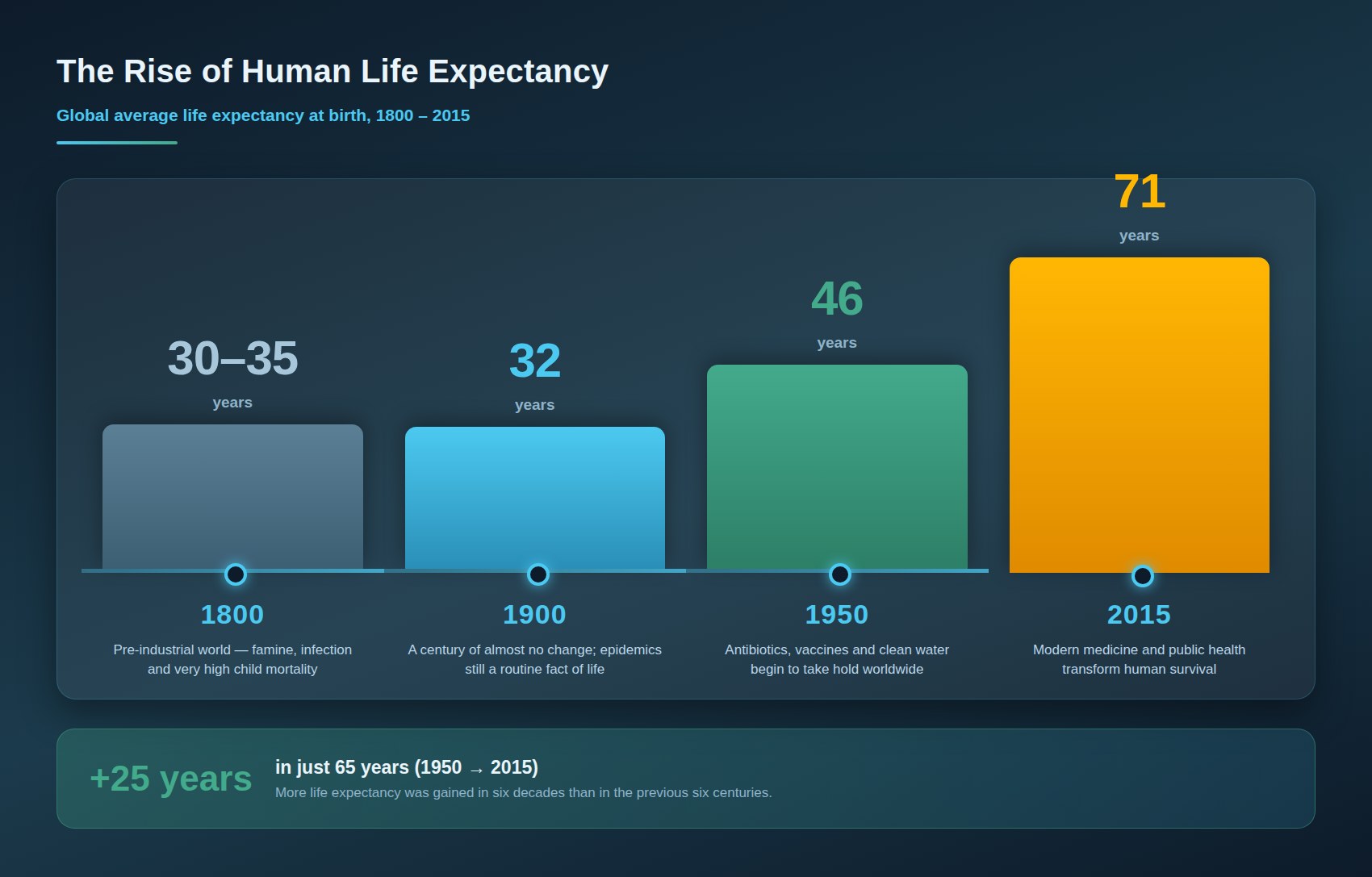
Until the 1800s, human life expectancy was only about 35 years.1 Had you been born in William Shakespeare’s lifetime, you might have lived thirty or forty years. It was only when doctors began, as a matter of routine, to wash their hands properly before and after surgery that life expectancy began to climb. After the discovery of penicillin, and with thorough sanitation established in hospitals, average lifespans rose further still. Modern science transformed medicine. Most people could at last be brought within reach of some kind of care. Modern healthcare drove death rates down across the world and life expectancy up.
In 1950 the global average life expectancy was just 46 years. By the 2015 figures it stood at 71. That is a gain of 25 years.
Behind the Growth of Population
As of 2020, the world holds roughly 760 crore (7.6 billion) people.2 In 1918 the total was only 20 to 28 per cent of that — somewhere between 175 and 200 crore (1.75 to 2 billion). One of the chief reasons for this enormous increase is the improvement in the human lifespan itself.
Chapter 2 — The Global Geography of Life Expectancy and Carbon
Life Expectancy, Continent by Continent
North America currently has the world’s longest-lived population, at roughly 80 years. Europe and South America follow, at 77.7 and 75.1 years respectively. Then comes Asia: a person living in an Asian country can expect on average 72.4 years. At the bottom of the list is sub-Saharan Africa, where the average lifespan is 59.3 years.
UNDP 2019: A Country-by-Country Reckoning
According to the 2019 report of the United Nations Development Programme (UNDP), India’s life expectancy is 69.4 years (70.7 for men, 68.2 for women) — 130th out of 186 countries.3 That is a long way below the developed world. India’s neighbours are, if only slightly, ahead of it: Bangladesh stands at 72.8 years and 108th place; Bhutan at 71.5 years and 115th; Nepal at 70.5 years and 124th. Pakistan is worse off than we are, at 67.1 years and 140th in the world. Hong Kong takes first place at 84.7 years, Japan second at 84.5. The United States, at 78.9 years, is 38th.
Where a country’s people live longer than the norm, the reason is inevitably that they live better. It is no accident that the countries near the top of the BBC’s World Happiness Report 2017 also have the highest life expectancies. A strong and growing economy; wide access to healthcare; robust immunity and a low cancer risk; nutritious food; the absence of crushing psychological stress; steady socio-economic development; and no discrimination in the delivery of health services — these are the reasons behind it. Notably, air pollution in those countries is also very low.
The Countries with the Shortest Lives
At the other end of the table, in 186th place, is the Central African Republic, where average life expectancy is 52.8 years. Chad sits at 184th with 54 years. According to WHO figures, the states with the lowest overall life expectancy are Sierra Leone, the Central African Republic, the Democratic Republic of the Congo, Guinea-Bissau, Lesotho, Somalia, Swaziland, Angola, Chad, Mali, Burundi, Cameroon and Mozambique. The root causes are an unhealthy environment and malnutrition. These countries have been battered by natural disasters of every kind, and matters have been made worse by attacks from neighbouring states. On top of all this, the AIDS epidemic there grows steadily worse. Polluted surroundings, undernourishment, the rising use of chemicals and much else besides all lie behind these short lives. To protect the human resources of these countries, the United Nations has called on their neighbours to step forward.
China, Carbon and a Change of Outlook
The People’s Republic of China — India’s neighbour, and lately its adversary — has a life expectancy of 76.7 years, 59th in the world. China has recently cut its carbon dioxide emissions by around 25 per cent. Air pollution also fell during the global economic downturn of 2008. The country has brought its transport sector, the single largest contributor to greenhouse gas emissions, under control. And it was from the Chinese city of Wuhan, in December 2019, that the coronavirus pandemic broke upon the world. Recently President Xi Jinping announced that China’s carbon emissions would peak by 2030, and that by 2060 the country would become carbon neutral.4 Is this change of outlook a product of the pandemic and the global recession?
The World Map of Per-Capita Carbon
During a recent United States presidential debate, Donald Trump claimed that Russia, India and China are the ones driving up the pollution in the air. America makes an effort to control air pollution, the President complained, but those three countries can never be seen taking any initiative at all.
According to the report of a commission constituted by the World Health Organization (WHO), UNICEF and The Lancet, the worst offenders on per-capita carbon emissions are the Middle East and the industrialised countries. Qatar comes first: each of its citizens is responsible for an average of 49 tonnes of carbon a year — 1,716 per cent above the global Sustainable Development Goal target for 2030. The United States ranks eighth in per-capita carbon use, at an average of 16 tonnes a person; to meet the SDG target it would have to cut that by 500 per cent. Australia stands above the United States. In China the figure is 7.05 tonnes a person, in Russia 11.74 tonnes.
India’s average per-capita emissions are lower than any of these, but in total annual carbon emissions it stands third, behind only China and the United States, with Russia fourth. Among the countries of South Asia, the lowest per-capita emitter is Nepal, at 26th place. The highest per-capita emitter in the region is India, where each person is responsible for an average of 1.84 tonnes of carbon — still, it should be said, comfortably below the SDG target. Bangladesh is 39th, at 0.53 tonnes per person per year, some 80 per cent below the level the SDGs allow. The world’s most environmentally benign countries are in Africa. The lowest emitter of all is Burundi, at a mere 0.05 tonnes per person; the figures for Chad and Somalia are the same. Nineteen of the world’s lowest-emitting countries are on that continent.
Chapter 3 — The Ganga and the Indo-Gangetic Air Crisis
The Plain Where Civilisation Began
The Ganga is not only a matter of Indian religious tradition and belief. The history of India is, in essence, the history of human settlement along the Indo-Gangetic plain. As the Indus Valley civilisation emerged and spread across the north-west of the subcontinent, sixteen major kingdoms and settlements known as the Mahajanapadas rose across almost the whole of the Gangetic plain. Today the Indo-Gangetic plain is one of the most densely populated regions on earth. Some 90 crore (900 million) people live there — a seventh of the world’s population.
The Polluted Ganga
That storied river is now one of the five most polluted rivers in the world. Near Varanasi, the faecal coliform count in its water runs a hundred times above the limit set by the Government of India. The pollution of the Ganga harms not only the tens of millions of Indians living along its banks; it harms 140 species of fish, 90 species of amphibian, and the Ganges river dolphin, India’s national aquatic animal. A scheme called the Ganga Action Plan was once adopted to clean the river up. Corruption, technical incompetence, the absence of any sound environmental planning and the refusal of various religious organisations to cooperate reduced the project to failure. Many now pin their hopes on the central government’s current efforts and the crores of rupees allocated to them. But over the sky of this rich and most crowded of valleys another danger has arrived, like a black shadow: air pollution.
Seven States, Seven Years
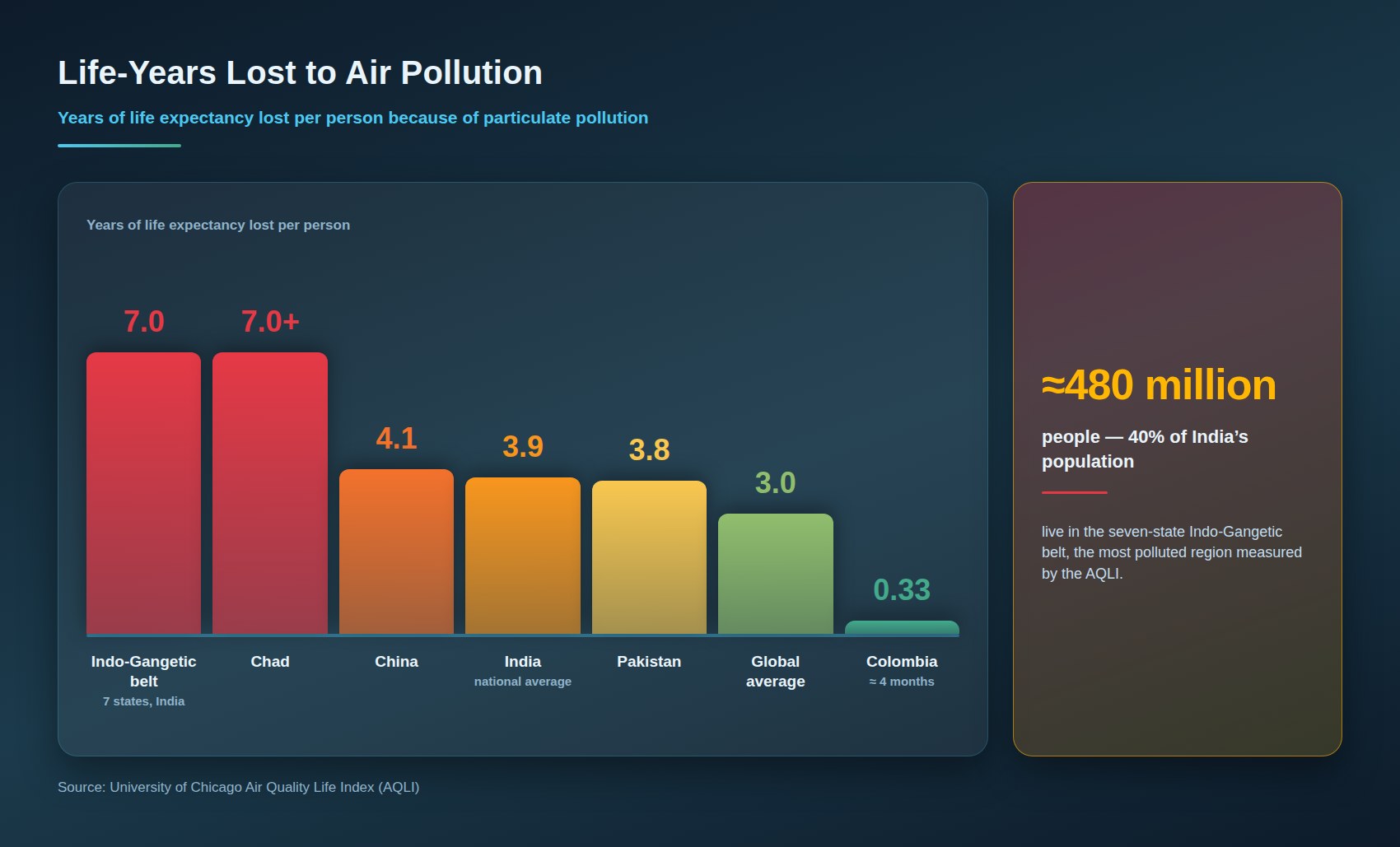
Analysis of the Air Quality Life Index (AQLI), run by the University of Chicago’s Energy Policy Institute (EPIC), has shown that air pollution has cut global average life expectancy by nearly three years. In the seven states of the Gangetic valley — Punjab, Chandigarh, Haryana, Delhi, Uttar Pradesh, Bihar and West Bengal — people may in future lose as much as seven years of life.5 That would have a devastating effect on some 48 crore (480 million) people. Roughly 40 per cent of the country’s population would see seven years cut from their lives.
The Air Quality Index and Delhi’s Distress
Delhi tops the list of the world’s most polluted capital cities. The state of the air in Delhi and the states around it makes it, at present, the most polluted capital on earth. Dhaka, in Bangladesh, comes next. Our own Kolkata’s air pollution is deeply worrying too. Conditions in the states surrounding Delhi have become so serious that the Supreme Court once declared a “health emergency”.
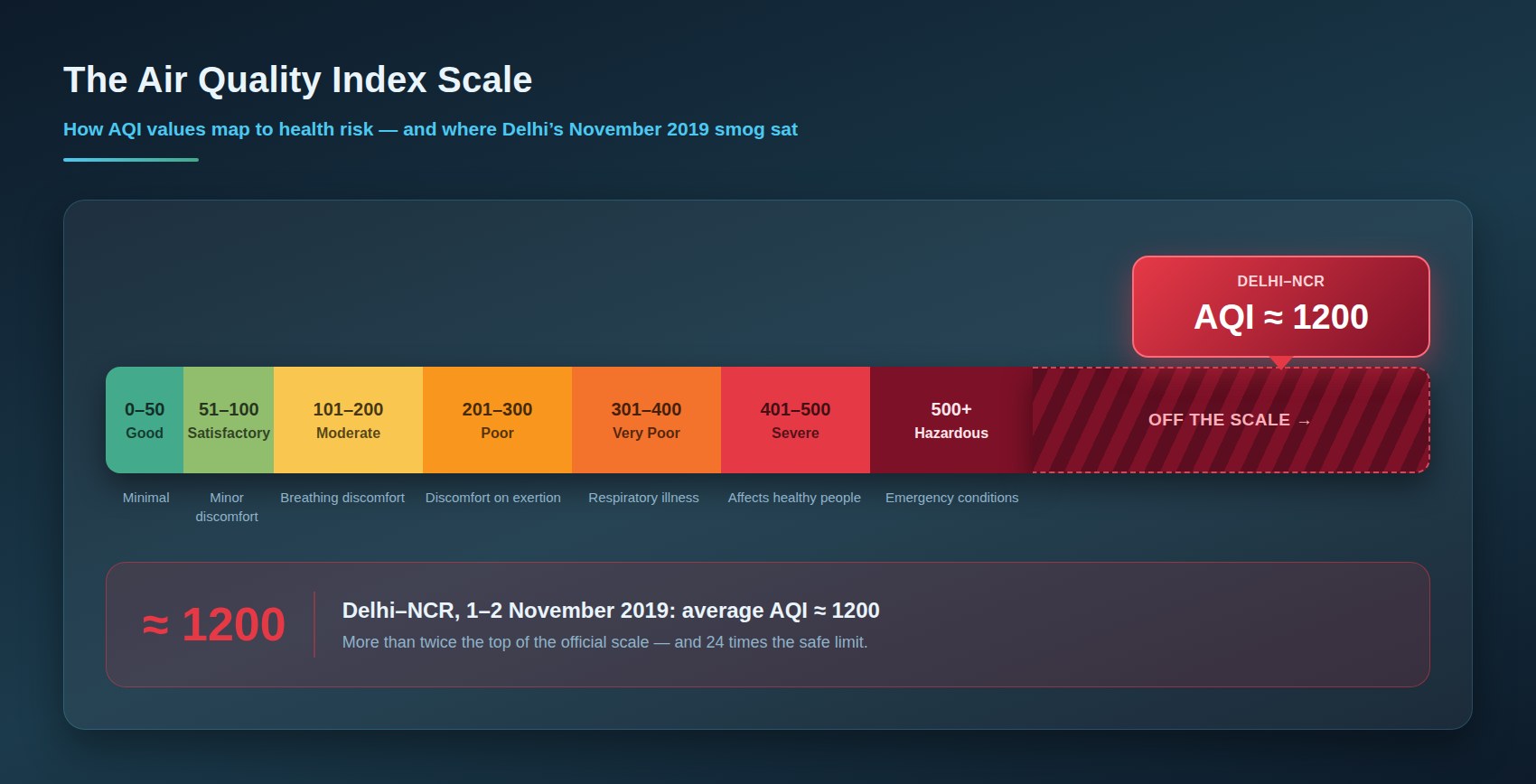
Ordinarily, an Air Quality Index reading between zero and 50 is good. From 51 to 100 is satisfactory. From 101 to 200 is moderate. From 201 to 300 is poor. From 301 to 400 is very poor. From 401 to 500 is severe. Anything above that is “severe plus”. On 1 and 2 November 2019, the average air pollution reading across the Delhi-NCR region was 1,200. It is not hard to imagine what state things had reached. A few days later conditions improved somewhat, dropping from “severe plus” back down to “severe”.
Chapter 4 — Air Pollution: A Silent Pandemic
Denial versus Science
The World Health Organization has stated that this pollution is responsible for a large share of India’s premature deaths. Union Environment Minister Prakash Javadekar recently told Parliament that no Indian study had ever been able to demonstrate any relationship at all between pollution and shortened lives. “The studies that have been conducted in India,” the minister said, “have not been able to show any relationship between pollution and the shortening of human life. It is therefore better not to create needless panic among the public.”
Responding to the minister’s claim, the WHO’s director said: “There is strong scientific evidence that severe air pollution affects human health. We would nonetheless urge the government to take the measures necessary to reduce pollution, because this air pollution is having a terrible effect on the bodies of the country’s citizens — particularly in those cities where pollution levels exceed the WHO’s recommended guidelines.”
The Arithmetic of Death
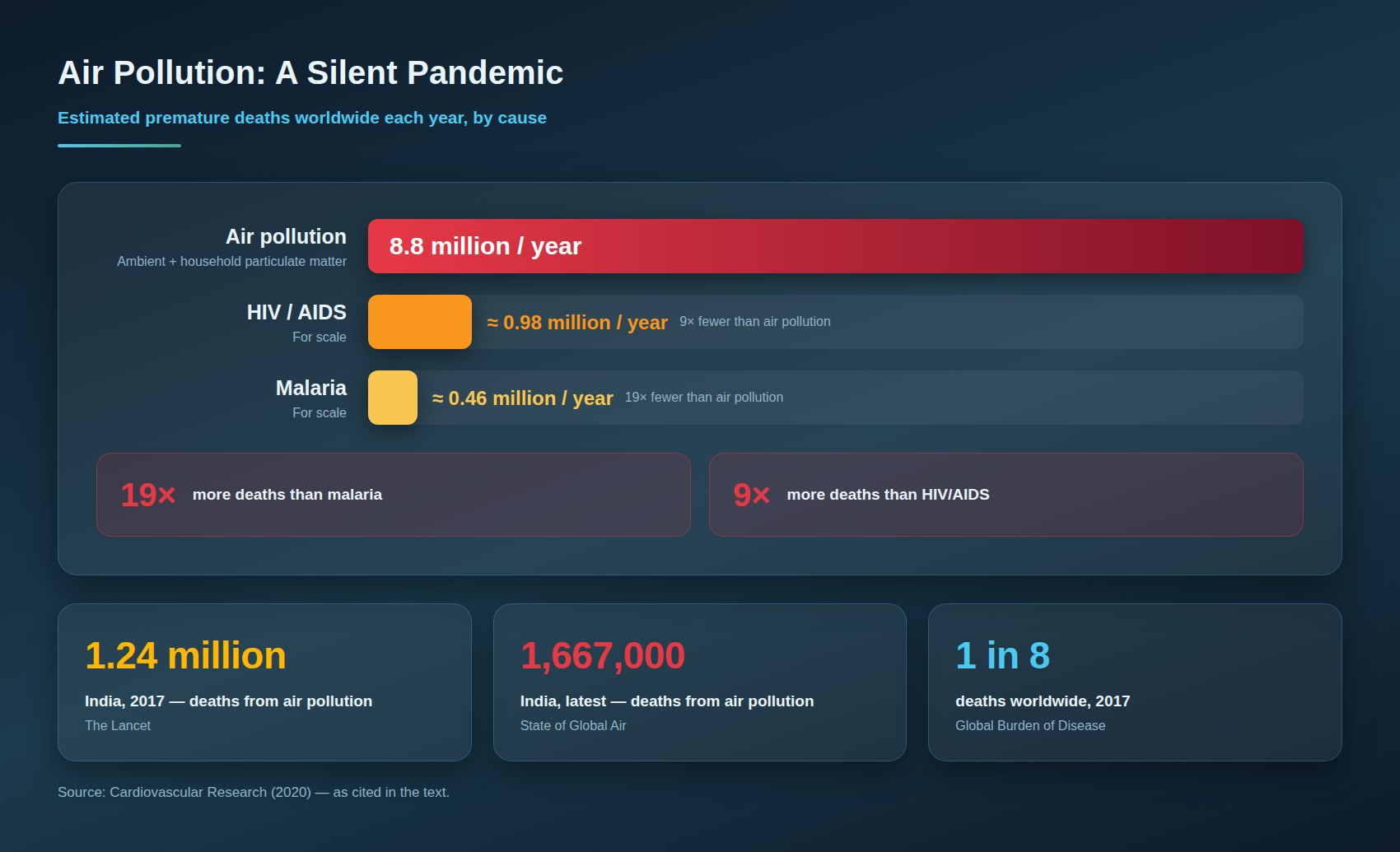
A study published in The Lancet found that in 2017, one death in every eight was caused by air pollution. The same study found that India suffers the greatest health damage from air pollution of any population in the world — the largest such burden anywhere. In 2017 alone, air pollution caused 12.4 lakh (1.24 million) deaths in India.6 Poisoned air is steadily driving the country’s death toll upward.
In the preceding year, too, Delhi’s air pollution robbed its residents of sleep. Pollution levels began climbing steadily from Diwali onwards. Breathing became something close to impossible for the people of Delhi. Both the state and the central governments were rebuked by the Supreme Court. As the WHO’s director put it: “The sooner the government acts, the sooner people will escape this death trap. If it delays, many more may fall victim to this air pollution.”
Worldwide, air pollution kills some 88 lakh (8.8 million) people before their time.7 Research carried out by the Delhi-based Centre for Science and Environment (CSE) has shown that in 2010 alone there were 620,000 premature deaths and child deaths in India, with the harmful effects of air pollution among the leading causes.
The Global Burden of Disease
According to the 2016 Global Burden of Disease report from the Institute for Health Metrics and Evaluation (IHME), 16 per cent of all deaths from disease worldwide were caused by cerebrovascular disease. Heart disease came second, accounting for 14.3 per cent.8 The next three places were held by chronic obstructive pulmonary disease (COPD), diabetes and lower respiratory infections. The conditions that kill the most people are driven by high blood pressure, air pollution, fine particulate matter suspended in the air, high blood sugar and smoking. Cerebrovascular disease (stroke) in particular is caused above all by smoking together with air pollution generally. Strict controls on both smoking and air pollution are therefore essential — and so is public awareness. In many respects air pollution does more to shorten human lives than tuberculosis, HIV/AIDS or smoking.
South Asia’s Poisoned Skies
This pollution has become a serious concern across South-East Asia. Nearly a quarter of the world’s people live in four South Asian countries — Bangladesh, India, Nepal and Pakistan — which are among the most polluted on earth. As early as 2014 the World Health Organization reported that 13 of the world’s 20 most polluted cities were in India. In its most recent report the WHO named Kanpur, in Uttar Pradesh, as the most polluted city of all, with airborne particulate levels roughly 17 times the safe threshold.9 With pollution levels 44 per cent higher than they were two decades ago, the people of these countries have lost five years of life expectancy.
Air Pollution by the Name of “Pandemic”
Air pollution now looks set to become a global pandemic in its own right. A study published in the international journal Cardiovascular Research identified air pollution as exactly that — a pandemic. The polluting particles produced by oil, gas, coal and other fossil fuels can remain in human lungs for up to a year. The effect of air pollution on public health is more damaging than that of smoking. Switching to renewable fuels could reduce that damage.
Air pollution kills more people prematurely than the great epidemics do. It causes 19 times as many premature deaths as malaria and roughly nine times as many as AIDS.10 Lung cancer alone accounts for around 6 per cent of deaths from air pollution. Its effects are also swelling, day by day, the numbers of patients with other lung diseases, high blood pressure and diabetes. Air pollution has cut average life expectancy by 4.1 years in China, 3.9 years in India and 3.8 years in Pakistan. “Roughly two-thirds of these premature deaths are attributable to man-made pollution. Reducing the use of fossil fuels could save some 55 lakh (5.5 million) people a year from dying before their time.”
The long-term effects of air pollution register at both national and regional levels, and they vary from country to country. In Chad, air pollution has cut life expectancy by more than seven years; in Colombia, by a little over four months. Two-thirds of the world’s premature deaths are caused by pollution, and that pollution is overwhelmingly of human making. The country’s policymakers and specialists must take the matter seriously now. If fossil fuel emissions alone could be brought down to zero, at least one year could be added to the average human life.
Disease, epidemic and unforeseen catastrophe have all left their mark on human life expectancy. There was a time when infectious and communicable disease played a far larger part in this than it does now. In 1990, one death in three was caused by infectious and communicable disease. By 2017 the figure was one in five.
Chapter 5 — COVID-19 and the Twin Pandemic
Salt in the Wound
Now, mimicking the diseases that air pollution itself produces — and landing, as the Bengali saying has it, like a sword-blow upon the dying — an RNA virus has invaded the human body: severe acute respiratory syndrome coronavirus 2, SARS-CoV-2 for short. Passing from person to person, it produces a disease called COVID-19. According to specialists, the disease has been most devastating for one in every six of those infected — people who already had serious respiratory conditions. Those with weakened immunity and the elderly (particularly anyone with high blood pressure, heart trouble or diabetes) are at greater risk of infection. And it is precisely that immunity which air pollution attacks. Our civilisation seems to have been caught in the mud of a whirlpool.
The Pandemic Declared, the Infection Spread
On 30 January 2020 the World Health Organization declared this viral disease a global health emergency, and on 11 March 2020 it declared coronavirus disease 2019 (COVID-19) a pandemic.11 The virus has now infected some 4.5 crore (45 million) people across 217 countries. To date it has killed roughly 12 lakh (1.2 million). Eighty-five per cent of those who have died of coronavirus were over 45. The United States has so far borne the heaviest burden. India follows, and the toll there keeps climbing — around 1.5 lakh (150,000) people have died. The recovery rate, however, is now passing 82 per cent. The World Health Organization has said there is no prospect of general vaccination before 2021. Where the damage to human civilisation from this pandemic will finally end is impossible to say.
Lockdown, the Economy and the Spectre of Famine
To fight the spread of coronavirus, countries around the world have declared states of emergency. Most have chosen the path of lockdown. More than 350 crore (3.5 billion) people worldwide have been confined by these measures. According to the World Health Organization, coronavirus has been detected in 217 countries, of which 90 have imposed full or partial lockdowns. But lockdown has brought whole economies to a standstill. The World Food Programme has warned that if the economy continues in this state, at least 3 crore (30 million) people worldwide could die of starvation. In some places the lockdown has kept people indoors for more than five or six months, throwing their food supply into complete uncertainty. With air and rail links and every other form of transport suspended, supply chains too have seized up. Tens of millions of people are living in hunger or half-hunger.
According to the World Health Organization, coronavirus may well have brought catastrophe upon hundreds of millions of people. Modern health services everywhere have been overwhelmed. Ordinary people’s non-COVID illnesses, and the delivery of public health programmes generally, have both fallen away dramatically — enough, in itself, to pull down the average human lifespan worldwide.
Two Papers, Two Warnings
Two recently published papers bear all of this out. The first, a study of coronavirus infection published in the journal PLOS One, found that COVID-19 is set to affect human life expectancy worldwide. According to its findings, the effect of coronavirus infection could reduce average life expectancy in the countries of Europe and North America by 10 per cent.12 The paper amounts to a warning: unless there is worldwide reform in healthcare, in socio-economic conditions and in education, the future will be very grave indeed.
The second, the State of Global Air report, brought disturbing news — air pollution alone killed 16.67 lakh (1,667,000) people in India last year.13 Air pollution, that report says, has become the single largest cause of death among both children and adults in India.
Chapter 6 — History Repeats — and the New Normal
The Spanish Flu: History Repeating
History, many are saying, has repeated itself. Just as the world shook in 1918 under the blow of the Spanish flu, so in 2020 it trembles under COVID-19. The Spanish flu spread through Germany, England, France, Spain and the United States in the spring of 1918. From there the killer virus — identified as H1N1 influenza — went on to engulf the entire world. That pandemic, which ran until 1919, killed some 2 crore (20 million) people worldwide.14 Around 50 crore (500 million) were infected. It spread amid the utter disorder of the First World War.
According to specialists, the H1N1 influenza virus destroyed the immune defences of young men and women by amplifying the cytokine storm. It struck those aged between 20 and 40 hardest of all. In the view of experts, it was the cramped and filthy conditions of wartime hospitals, army camps and settlements, together with widespread malnutrition, that turned an ordinary influenza into the deadly Spanish flu. According to the United States National Library of Medicine (NCBI), the Spanish flu pushed mortality in American army camps up by roughly 5 to 10 per cent. In the British Army in India it raised the death rate among white soldiers by 9.6 per cent and among Indian soldiers by 21.9 per cent. So severe was the pandemic that life expectancy in the United States fell by around ten years. Across the world, too, average life expectancy dropped sharply at a stroke.
Like COVID-19 today, the Spanish flu was a respiratory virus, and much the same protective measures were adopted against it. Masks were worn by everyone — patients and doctors, sanitation workers and police officers alike. The sick were placed in quarantine then as now. And to relieve the loneliness of those in quarantine, cut off from society — since there was neither social media nor television — the telephone was the one recourse. Advertisements urging people to wear masks and to keep in touch by telephone with those in quarantine circulated widely in the newspapers and publicity campaigns of the day.
The HIV-AIDS Crisis
A textbook case of a pandemic shortening human lives is the HIV-AIDS crisis of the 1980s. It shook the whole world. Its effect on life expectancy in the countries of North Africa in particular was striking.15 Decades of improvement in survival were reversed to a marked degree. With the arrival of anti-retroviral therapy, better treatment and widespread public awareness of prevention, global deaths from AIDS fell within a single decade — from roughly 20 lakh (2 million) to 10 lakh (1 million). From that point on those countries began to recover some of their lost life expectancy. Even now, though, life expectancy across these parts of Africa remains confined to between 50 and 55 years.
Progress and the Numbers
Other pandemics have shaken the world before. Vaccination against preventable disease has brought death rates down. Sanitation, an understanding of hygiene, nutrition, immunisation and basic healthcare have all played their part in the improvement. The figures show that some 5.6 crore (56 million) people died worldwide in 2017. That is more than a crore (10 million) higher than the 1990 figure, and yet the death rate is lower — the reasons being, of course, global population growth and the fact that people are living longer on average.
Nature’s Reprieve Under Lockdown
With people confined indoors by the lockdowns imposed to halt the pandemic, nature reaped the benefit. The National Aeronautics and Space Administration (NASA) reported: “It is this lockdown that has brought India’s air pollution down so sharply at a stroke. For the first time in twenty years, a major change can be seen in the atmosphere over northern India. Over the Gangetic basin in particular, NASA’s satellite imagery for this time of year shows aerosol levels in the lockdown air fallen so far that the drop can fairly be called historic.” Aerosols are the tiny solid or liquid particles that mix with the air and reduce visibility. Suspended in the air as they are, they are known to damage the human lungs and heart as well.
Comparing conditions during the anti-COVID lockdown with the preceding five years shows that air pollution fell markedly over the period. In the commercial capital, Mumbai, harmful suspended particulate levels fell by 10 per cent, and in Delhi by 54 per cent. In Kolkata and three other cities the reduction ranged between 24 and 32 per cent. This long lockdown showed us, in the plainest possible terms, what our way of living does to the planet. Transport accounts for 23 per cent of global carbon emissions. Those emissions fell under the short-term lockdowns imposed as public health measures against COVID-19. The greatest single benefit of the lockdowns brought in to check the spread of coronavirus is that people the world over have been able to breathe air far freer of pollution.
According to the World Health Organization, more than 80 per cent of the world’s urban population is exposed to air well above the safe limits of air quality standards. Conditions in the world’s less developed countries are worse still: 98 per cent of their cities fail to keep air quality within WHO limits. The 2015 report of the State of Global Air, out of Boston, stated: “The death rate from pollution in India is roughly 13 times that of Bangladesh and 21 times that of Pakistan. The figures show that some 92 per cent of the world’s people are living in polluted air. Air pollution is a growing concern across the entire planet. Long-term work by researchers has found that since 1990 the incidence of some 300 diseases has risen in 195 countries, with air pollution the single largest factor behind it.”
Nature Reawakened
While human civilisation the world over has surrendered helplessly to the coronavirus and counts the hours until deliverance — until a vaccine arrives — nature has been rejoicing in the restoration of its balance. With people shut indoors by lockdown in more or less every city of every country, the animal world has come out to play. Every day we see, on social media, footage of one creature or another walking through the streets of one city or another. The principal reason for it is, of course, the fall in everyday human activity and in the various forms of pollution that humans generate.
The Lessons of the New Normal
The long lockdown imposed for COVID-19 gave the public a chance to grasp just how clean and pure the environment can be. That realisation could later play a major part in matters of environmental protection, and could send a particular message to those who make environmental policy. What counts as normal in the post-coronavirus world, and in this country, is something we ourselves will have to decide. This environmental lesson of the lockdown will certainly open the way for discussion and debate in years to come.
If the recent gains in air quality are to be made permanent, fossil fuels will have to be replaced by renewable energy and other low-carbon sources. Alongside the demand for a single national emission standard, specialists are also calling for a great expansion of public transport. That does not mean buying large numbers of buses and adding them to the fleet. What is needed instead is a system that persuades citizens to use public transport in place of private cars — because private cars are responsible for 70 per cent of urban air pollution.
A brief spell of unpolluted air may prove no more than a sliver of light in the black sky of the COVID-19 pandemic. But over the long run it can serve as a message to us. Environmental pollution is not only killing people the world over; it is giving birth to new diseases. Viruses like the coronavirus emerge, strike hundreds of millions of people as pandemics, and carry the world quietly towards deep mortality. According to specialists, sulphur dioxide, nitrogen dioxide, carbon monoxide, PM2.5, PM10, ozone (O₃), ammonia and a range of other substances all begin to damage the human body the moment they exceed normal levels in the air, multiplying the risk of allergies, lung cancer, heart disease, COPD, asthma and bronchitis several times over. For the moment, though, the lockdown has given the air some relief. Is lockdown, then, about to become what the environment demands of the world to come?
The Minds Lost to Pandemics
Age after age, hundreds of millions of people have lost their lives to health catastrophes and pandemics. Many famous figures have been struck down by such diseases; many others spent those years confined at home. Charles VIII of France, Christopher Columbus, Hernán Cortés, Leo Tolstoy, Nietzsche, Baudelaire, Maupassant, the German poet Heinrich Heine, Mussolini, Hitler, Lenin, the great Dutch painter Rembrandt — and in Bengal, Sarat Chandra Chattopadhyay and Rabindranath Tagore himself. The work they produced in those extraordinary and calamitous days has taken a place of its own in world literature.
Pandemics and incurable illnesses have also carried off many brilliant minds. Sukumar Ray, the writer for children who gave Indian literature its tradition of nonsense verse, contracted kala-azar (visceral leishmaniasis), then epidemic in Bengal. That rarest of talents was extinguished at the age of just thirty-seven.16 The poet Sukanta Bhattacharya, stricken first by malaria and then by incurable tuberculosis, was lost to us at only 21. In the same way the great poet John Keats died of tuberculosis at the age of just 25. Amadeus Mozart, the celebrated Austrian composer of the classical era of Western music, was carried off by various incurable illnesses at 35. And Swami Vivekananda, the great soul of Hinduism in India and the world beyond, left this life at the age of only 39; many specialists have said that a cerebral stroke may have been the cause of his passing.
Chapter 7 — Lockdown: A Signpost Against Global Warming
(Original essay: 2020; this chapter is drawn from a separate essay by the author)
A World Caught Between Two Dangers
The spread of the coronavirus across the globe has caught the world between two dangers. The first is a crisis of public health, the second a crisis of the economy. The helplessness of our health systems throws down a challenge to human civilisation with every passing day; and the lockdowns that followed from it have struck, swiftly and hard, at the great mass of the world’s poor, pushing tens of millions of people into unemployment.
Inside that second crisis lies a moral claim which, if it is evaded, leaves the whole discussion incomplete. When the poor are compelled to stay indoors, providing for their lives and their livelihoods is not charity — it is a founding demand of human civilisation. A state that takes away a person’s right to move about takes on, by that very act, the duty of feeding that person. How far local government machinery met that demand in confronting this worldwide catastrophe is a reckoning history will ask for.
To fight the deadly virus that spread out of the Chinese city of Wuhan, states of emergency have been declared in country after country; to hold back COVID-19, many have chosen the path of lockdown. As this is being written, coronavirus has been detected in 185 countries; 82 of them have imposed full or partial lockdowns, and across the world more than 300 crore (3 billion) people have been forced to stay at home.17 In some places that confinement has now run for more than four months.
The lockdown has brought the whole economy to a standstill. With air and rail links and every other form of transport suspended, supply chains have seized up, and the food system has been thrown into acute uncertainty. As we saw in Chapter 5, the World Food Programme has warned that if the economy continues in this state, at least 3 crore (30 million) people worldwide could die of starvation. Tens of millions are living in hunger or half-hunger. In the words of the World Health Organization (WHO), COVID-19 has probably brought disaster down upon tens of millions of people.
And yet, right alongside this suffocating picture, an entirely opposite one has come into view. With human beings shut indoors, nature seemed to breathe again. This chapter is about that second picture — and about what lessons the future might take from it.
25 March: A Country Draws Breath
To reduce the spread of coronavirus, the whole of India came under lockdown from 25 March 2020.18 The benefits of that confinement, which lasted some two and a half months, showed up most clearly of all in the natural world.
NASA’s satellite imagery was described in detail in Chapter 6 — for the first time in twenty years, aerosol levels in the atmosphere over northern India, and over the Gangetic basin in particular, fell so far that the drop can fairly be called historic. Rather than repeat those figures here, let us put a different question: was this decline an Indian phenomenon alone, or does it have any parallel elsewhere in the world?
Five Cities, Two Continents
The answer came from a study published in the journal Sustainable Cities and Society. Comparing air pollution during the lockdown with the same period over the preceding five years, the researchers showed that levels of harmful suspended particulate matter (PM2.5) had fallen markedly in five major Indian cities — by 10 per cent in Mumbai, 54 per cent in Delhi, and between 24 and 32 per cent in Kolkata and the other three (these figures were discussed in Chapter 6).
But the most intriguing part of the study lies outside India. The researchers set the fall in pollution in the Indian cities beside those in Vienna, the Austrian capital (60 per cent), and Shanghai in China (42 per cent).19 The phenomenon, in other words, was no India-specific accident. A wealthy city in central Europe, a vast industrial metropolis in East Asia and a South Asian capital — three wholly different economies, different climates, different sources of pollution — all responded in the same direction once the same cause, the daily activity of human beings, was taken away.
That is the great gain of these two and a half months. The lockdown showed us, by pointing a finger at it, exactly what our way of living does to the planet. Air pollution is no inexorable fate; it is the direct result of our own habits, and when those habits change, it changes within a matter of weeks.
The Skies of New York, the Factories of China
Across the ocean the picture is the same. According to NASA’s data, pollution levels in March 2020 in New York and the other big cities of the United States were 30 per cent below the average of the previous five years.20
And if one looks at the sources of emissions, the biggest name of all belongs to Asia. China alone emits more than 50 per cent of all the carbon dioxide produced in Asia — and during the pandemic a large part of that went unemitted for several months. A reduction of roughly 10 per cent in CO₂ emissions across China is the equivalent of taking an enormous number of cars off the roads.21
The chief reason behind all these reductions is transport. As noted in Chapter 6, transport systems account for about 23 per cent of the world’s total carbon emissions. Look inside those transport emissions and the main contributors turn out to be road vehicles (72 per cent) and aviation (11 per cent).22 The two activities we take to be the most ordinary parts of modern life — driving out every day and getting on a plane — are the source of the lion’s share of transport-driven warming. Both stopped dead under lockdown, and the result was visible from orbit.
One caution is essential here. These reductions happened over the short term, and only in those countries obliged to take stringent public health measures because of COVID-19. They were the result of an accident, not of policy. Once the accident is over the old picture is bound to return — unless we deliberately change something.
The Pollution You Cannot See, but Can Hear
Almost every large city in the world has, alongside its air pollution — and in tourist cities more acutely still — another problem that shows up less often in the statistics: noise pollution. According to the World Health Organization’s estimates, more than 10 crore (100 million) people across Europe are affected in one way or another by noise pollution.23
Noise pollution does not merely harm human beings physically and mentally; for other creatures it is nothing less than a death trap. To a whale or a dolphin that finds its way by sound waves, the unrelenting roar of a ship is the equivalent of blindness. For a bird that calls to find a mate, traffic noise reduces its very chances of breeding. Under lockdown the world fell silent for a few months — and the beneficiaries of that silence were, above all, the species other than our own.
Under the Water, and On It
The change came to aquatic environments as much as to land. With most shipping halted, water pollution has been almost nil, and the water has run clear. As vessels grew scarce, sea fish began to come closer inshore, and the dolphins hunting them came near the beaches too, revelling in their own games in the quiet.24
The picture on land that appeared in Chapter 6 — deer, nilgai and leopards wandering out of the forest into human settlements — has its counterpart in the water. In the present situation nature is reminding us that the earth does not belong to human beings alone; it is the vessel that holds several million other species besides. Try to destroy nature and nature mounts a resistance in its own fashion, and against that the whole of human civilisation is left helpless.
The Value of Unpolluted Air
The greatest benefit of the lockdown — that for a short time the people of the earth were able to breathe comparatively unpolluted air — can be measured by looking at the death toll in ordinary times. According to a widely cited WHO estimate, some 30 lakh (3 million) people die worldwide every year from diseases caused by air pollution.25 As we saw in Chapter 6, more than 80 per cent of city dwellers breathe air outside safe limits, and 98 per cent of the cities of the developing world fail to meet the standards set by the World Health Organization.
According to specialists, sulphur dioxide, nitrogen dioxide, carbon monoxide, PM2.5, PM10, ozone (O₃), ammonia and a range of other substances all multiply the risk of allergies, lung cancer, heart disease, COPD, asthma and bronchitis several times over the moment they exceed normal levels in the air. Environmental pollution is not only killing people; it is giving birth to new diseases as well — and one of them is called COVID-19.
Will Nature’s Challenge Become a Habit?
The long COVID-19 lockdown gave people the chance to see just how clean and pure the environment can be. That understanding may in time carry a particular message into the making of environmental policy. In the post-coronavirus world it is for us to decide what counts as “normal”.
But it is easy to reach the wrong conclusion. Making these recent gains in air quality permanent will require not repeated lockdowns but structural change — replacing fossil fuels with renewable and low-carbon energy. A brief spell of unpolluted air may prove no more than a sliver of light in the black sky of COVID-19; but over the long run it is a message to us, an experimental demonstration that change is possible and that its results are visible almost at once.
It is as though nature, through the lockdown, has found a protective charm for keeping its balance — one meant to save the future earth from global warming. And so the question comes back in the end to us: to save the earth of the future from global warming, is the human species prepared to turn this standing challenge from nature into a habit?
Conclusion
How far the human lifespan will be pushed back by the shock of this worldwide twin pandemic of the deadly coronavirus and air pollution, only the future will tell. How much the death rate rises in the “new normal” world under the force of these two pandemics is a question that future research will have to answer.
What can be said at the end is this. As human beings we will naturally wish to die well; that is only to be expected. But if we are to enjoy life and, along with it, live long in health and happiness, we need a well-planned system of universal healthcare together with a life in which pandemics are held in check. Today pollution, in the shape of a demon, is challenging the very life force of the earth.
“While there is breath in this body of mine, with all my strength I shall clear the world of its filth; I shall leave this earth fit for this child to live in — to the newborn, this is my unbreakable pledge.”
—Sukanta Bhattacharya
If we cannot carry that pledge of life resolutely forward, future generations may not even see the light of the sun in which to lay the blame at our door.
Appendix — On the Fact-Checking Notes
This essay was written in 2020, and every statistic, report, ranking and date in it reflects the information and the circumstances of that time. In preparing this edition in 2026, the significant claims in the text were independently checked against reliable sources including WHO, UNDP, the University of Chicago (AQLI), The Lancet, IHME, NASA, State of Global Air and Our World in Data.
On the whole the essay’s principal statistics survived that checking. Roughly 88 lakh (8.8 million) air pollution deaths worldwide each year; 12.4 lakh (1.24 million) in India (2017, The Lancet) and 16,67,000 (about 1.67 million) according to State of Global Air; the loss of seven years of life on the Indo-Gangetic plain (AQLI); the identification of Kanpur as the world’s most polluted city (WHO); Xi Jinping’s 2030/2060 carbon commitments; and the dates of the WHO’s declarations on COVID-19 (30 January and 11 March 2020) — all of these were borne out.
In a number of places significant corrections were needed. These have been marked impartially in editorial footnotes at the relevant points, with the original text left intact — the death toll of the 1918 Spanish flu, for instance, or the UNDP 2019 rankings, the interpretation of the PLOS One study, Sukumar Ray’s age at death, the world population in 2020, and the regional impact of HIV/AIDS. A few highly specific decimal figures (per-capita carbon values, the city-by-city percentage reductions in pollution and so on) do derive from genuine reports, but checking each individual number against the underlying tables lay beyond the scope of this exercise. Readers are asked to read the text in the context of 2020.
References
The author’s original acknowledgements (2020): 1) BBC News, 2) Stanford Magazine, 3) Wikipedia, 4) the NIEHS website, 5) material from the United States National Library of Medicine (NCBI), and 6) news reports published in various newspapers.
Editorial fact-checking sources (2026):
- Our World in Data — Life Expectancy: https://ourworldindata.org/life-expectancy-globally
- Our World in Data — Spanish Flu: https://ourworldindata.org/spanish-flu-largest-influenza-pandemic-in-history
- Worldometers — World Population by Year: https://www.worldometers.info/world-population/world-population-by-year/
- UNDP — Human Development Report 2019 (India): https://india.un.org/en/163171-india-makes-modest-progress-2019-human-development-report
- CDPP — India ranks 129 of 189 on HDI (HDR 2019): https://www.cdpp.co.in/articles/india-ranks-at-129-among-189-countries-on-hdi-un-human-development-report-2019
- database.earth — Life Expectancy 2019: https://database.earth/population/life-expectancy/2019
- WHO–UNICEF–Lancet Commission, “A Future for the World’s Children?” (2020): https://www.who.int/news/item/19-02-2020-world-failing-to-provide-children-with-a-healthy-life-and-a-climate-fit-for-their-future-who-unicef-lancet
- The Lancet — WHO–UNICEF–Lancet Commission report: https://www.thelancet.com/journals/lancet/article/PIIS0140-6736(19)32540-1/fulltext
- Climate Home News — Xi Jinping 2030 peak / 2060 carbon neutrality: https://www.climatechangenews.com/2020/09/22/xi-jinping-china-will-achieve-carbon-neutrality-2060/
- Openwaterpedia — Ganges / Pollution of the Ganga: https://openwaterpedia.com/wiki/Ganges
- EPIC, University of Chicago — Air Quality Life Index (7-year loss, Indo-Gangetic plain): https://epic.uchicago.edu/news/bad-air-cutting-lives-short-by-7-years-in-hindi-heartland-study
- Down To Earth — Indo-Gangetic residents live 7 years less: https://www.downtoearth.org.in/news/air/indo-gangetic-plain-residents-live-7-years-less-than-other-indians-study-67522
- Health Policy Watch — Delhi world’s most polluted capital: https://healthpolicy-watch.news/indias-air-quality-index-improves-but-delhi-remains-worlds-worst-polluted-city/
- The Lancet Planetary Health — India air-pollution deaths 2017: https://www.thelancet.com/journals/lanplh/article/PIIS2542-5196(18)30261-4/fulltext
- Al Jazeera — India’s polluted air killed 1.24 million in 2017: https://www.aljazeera.com/news/2018/12/6/indias-polluted-air-killed-1-24-million-in-2017-study
- IHME / Our World in Data — Causes of Death (Global Burden of Disease): https://ourworldindata.org/causes-of-death
- CSE India — 13 of 20 most polluted cities in India (WHO 2014): https://www.cseindia.org/who-says-india-ranks-among-the-worlds-worst-for-its-polluted-air-out-of-the-20-most-polluted-cities-in-the-world-13-are-in-india-5402
- BBC News — Kanpur world’s most polluted city (WHO): https://feeds.bbci.co.uk/news/world-asia-india-43972155
- Cardiovascular Research (Lelieveld et al., 2020) via ScienceDaily — air pollution as a “pandemic,” 8.8 M deaths, 5.5 M saveable: https://www.sciencedaily.com/releases/2020/03/200302200734.htm
- Newsweek — Air pollution vs malaria (19×) and AIDS (9×): https://www.newsweek.com/air-pollution-pandemic-smoking-malaria-1490046
- PLOS One — Assessing the potential impact of COVID-19 on life expectancy (2020): https://journals.plos.org/plosone/article?id=10.1371/journal.pone.0238678
- Worldometers — COVID-19 global figures / WHO declarations: https://www.worldometers.info/coronavirus/
- Worldometers — COVID-19 India: https://www.worldometers.info/coronavirus/country/india/
- NASA Earth Observatory — Airborne particle levels plummet in northern India: https://earthobservatory.nasa.gov/images/146596/airborne-particle-levels-plummet-in-northern-india
- State of Global Air / The Lancet Planetary Health — India 1.67 million air-pollution deaths: https://www.thelancet.com/journals/lanplh/article/PIIS2542-5196(20)30298-9/fulltext
- Stanford University — 1918 influenza and U.S. life expectancy: https://virus.stanford.edu/uda/
- Wikipedia — Sukumar Ray: https://en.wikipedia.org/wiki/Sukumar_Ray