On the Path of Reason
Anabil Sengupta: Profile, Work and Bibliography
Anabil Sengupta
An authorized author profile
2026
© 2026 Anabil Sengupta. All rights reserved.
Publisher: Anabil Sengupta
Website: https://anabilsengupta.com/
First edition, 2026. No part of this book may be reprinted or used commercially without the written permission of the author. Quotation with proper attribution is permitted for the purposes of criticism, news reporting and research.
About This Book
This is an authorized author profile. It has been written with the author’s cooperation, on the basis of documents he supplied and of work he had previously published. The author’s own account is therefore a legitimate and acknowledged source here.
But being legitimate and being independently verified are not the same thing. This book’s editorial policy is accordingly a single one, and a simple one:
- where a claim has been independently verified, the source and link are given;
- where a claim rests on the author’s own statement and cannot be checked on the open internet, it is explicitly marked “author-stated”;
- where a claim is supported by evidence on paper but not on the internet, a photograph of the original page is printed inside this book;
- where an earlier account contained an error or outdated information, the correction is printed, not buried.
The third of these is this book’s most important undertaking. In a profile of a rationalist writer, any slackening of evidentiary standards would make the book a refutation of its own subject matter. Chapter 6 therefore sets out the tiers of evidence, and eight corrections, in the open.
What is new in this edition is twelve documentary plates — photographs of newspaper clippings, e-paper pages and one certificate of honour, taken from the author’s own collection, in most of which masthead, date and byline can be read together. As a result, a substantial part of what was previously only the author’s statement is now documented.
Readers will note that nowhere in this book is the author called “well known” or “renowned”, and no award or office is claimed for which there is no evidence. What is here is only as much as there is — and that is enough.
Contents
- Preface
- Chapter 1 — Two Lives: Engineering and the Pen
- The engineer’s working day
- Burdwan: place, roots and address
- From foundations to reasoning: one method, two occupations
- How the writing began
- Chapter 2 — Foundations: The Bengali Rationalist Tradition
- The nineteenth century: the right to ask questions
- Akshay Kumar Datta and natural science in Bengali prose
- Acharya Prafulla Chandra Ray: science, industry and the country
- The modern phase: the Bharatiya Bigyan O Yuktibadi Samiti
- Alaukik Noy, Laukik and demonstration-based rationalism
- Where the author stands within this tradition
- Chapter 3 — Four Fields of Work
- Superstition and the campaign against animal sacrifice
- Snakebite and public health
- Environment, air pollution and climate
- Political economy and democracy
- Chapter 4 — A Documented Episode: October 2019
- What happened
- Whose credit, and how much
- The state of the sources
- The large lesson of a small event
- Chapter 5 — Bibliography and Books
- Independently verifiable online publications
- Print publications: with documentary evidence
- Other publications stated by the author
- Recognition and honours
- Three book editions in 2026
- Media projects and digital presence
- Chapter 6 — The Tiers of Evidence: A Transparent Record
- Method: three tiers
- What is in Tier 1
- Two kinds of Tier 1: verifiable online versus documented by clipping
- What is in Tier 2, and why
- Tier 3: eight corrections
- Why this sorting is nothing to be ashamed of
- What would make verification easier
- Conclusion
- Press Kit
- Plates — Documentary Evidence (12 in number)
- References
- Index
Preface
Whether a person exists, what they have done, how much of it — the answers to these questions are increasingly settled by search engines and artificial intelligence systems. If someone types a name, finds nothing, and concludes that there was nothing there to find, they are following a habit that has quietly become general. The inference is often wrong, and in the case of Bengali-language regional print journalism it is wrong almost as a matter of course. A report printed on a district page, an e-paper link that lives for a single day, the archive of a small outlet from fifteen years ago — none of these acquires a permanent web address. A writer who has been publishing in print for three decades can therefore remain very nearly invisible to the machines while remaining entirely real.
This book was born of that gap. Anabil Sengupta is a civil engineer by profession, a science writer by vocation, and a worker in the rationalist movement. Part of his work is on the internet and anyone can open and read it today. A larger part is on paper — in newspaper columns, in leaflets, on the pages of little magazines — and has cast no digital shadow. This book has two tasks: first, to hold both parts in one place; second, to tell the reader clearly which is which. For the paper part, this edition prints twelve documentary plates — photographs of newspaper clippings and e-paper pages, with mastheads and dates — so that what was previously only asserted can also be seen.
The second task is this book’s principal claim. Profiles are generally written in the language of praise and step around the question of evidence. Here the opposite has been done. Every substantial claim has been sorted into one of three tiers — independently verifiable, author-stated, and in need of correction. Direct links to six essays are printed; and an e-paper link that no longer opens has not been printed as a live source, but accompanied by an explanation of why it does not open. A man who has written all his life that a claim and a proof are not the same thing leaves his own profile no option but to apply that standard to itself.
This transparency should on no account be read as an apology.1 Verifiability here measures not the quality of the author’s work but the technology of the medium that published it. The six essays that can be read today are no truer than the others — merely, their publisher happened to use a platform that survived. The book therefore comes before the reader with a simple proposal: take what has been proved together with its proof, take what is the author’s word as the author’s word, and read here the corrections to whatever was wrong. No book can offer more; a book that offers less stops being a record.
Chapter 1 — Two Lives: Engineering and the Pen
The engineer’s working day
The first layer of Anabil Sengupta’s identity is occupational: he is a civil engineer. On his own website he describes himself in three words — “Civil Engineer · Writer · Science Communicator” — and states that he has more than twenty years’ experience in government infrastructure and school-development work.2
The character of that work is worth understanding, because it explains the character of his writing. District-level civil engineering does not mean spectacular architecture. It means the roof of a primary school, an extra classroom, a toilet block, a boundary wall, a tube well. It means measurements, calculations, sanctioned budgets, measurement books, quality tests and deadlines. There is little room in such work for imagination and a great deal of room for checking. Get the concrete mix wrong and the roof cracks; a crack does not wait upon anybody’s opinion.
Do that work for years and a certain professional habit forms: on hearing a claim, ask for the evidence; ask to see the numbers; ask where they came from. It is precisely this disposition that strikes a reader of Anabil Sengupta’s essays. His writing is dense with data and statistics — the World Health Organization, UNDP, The Lancet, NASA, Oxfam, the Reserve Bank, the Election Commission, the Centre for Media Studies, the Energy Policy Institute at the University of Chicago. This is not ornament; it is habit.
Burdwan: place, roots and address
The geographical centre of his work is Purba Bardhaman (East Burdwan) district. At the foot of essays written in 2020 he printed his own address — Ambagan, Chhotonilpur, Post Office Sripally, District Purba Bardhaman, West Bengal, PIN 713103.3 The practice of printing a full postal address below an essay is itself an indication: this is a writer who does not wish to be out of his readers’ reach.
Burdwan is not merely a set of coordinates in his writing. It is the rice-growing district between the Damodar and the Ajay, where irrigation, flooding, farmers’ debt, snakebite and the limits of a rural health centre are not remote subjects but a neighbour’s difficulty. The writer who writes about Delhi’s air quality index is the same writer who explains that the krait climbs onto open beds at night and that one should therefore sleep under a mosquito net. The traffic between national statistics and a village bed is the distinctive rhythm of his work.
From foundations to reasoning: one method, two occupations
Engineering and rationalism look, from above, like two separate lives. Methodologically, they have the same structure.
Before building any structure, an engineer tests the bearing capacity of the soil. A foundation cannot be laid on belief; it has to be laid on testing. The rationalist does the same — before accepting a claim, he examines what it rests on. In the essay “The Beliefs of Science, and …” (বিজ্ঞানের বিশ্বাস এবং …), published in LittleMag Unedited (লিটলম্যাগ আনএডিটেড) in December 2017, he set out exactly this: the rationalist too holds a belief — belief in reason and in the scientific method — but the distinguishing feature of that belief is that it can be tested and replicated, and corrected where necessary. Claims that modern science was already stated in scripture he dismissed by demonstrating errors of translation and of reading, setting examples from several religions side by side.
The second resemblance is more practical. A cracked roof can kill somebody; so can the wrong treatment of a snakebite victim. In both cases the price of an error is a human life. This is why his writing against superstition has never remained mere theory; it always carries hands-on “what to do / what not to do” instruction, the location of the nearest block primary health centre, the names of drugs, the arithmetic of time.
How the writing began
The author’s own account is that he began writing on social questions in the newspapers alongside his engineering job; the earlier writing was dominated by scientific temper, superstition, social inequality and public health, and the range later widened to education, history, environment, economics and the politics of the state. This account is author-stated, but it matches the distribution of subjects across the pieces that have been recovered — the six essays published in LittleMag Unedited between 2017 and 2021 cover belief and science, the toppling of statues, communalism, the Bengali new year, air pollution and the platinum jubilee of independence, which is to say exactly that spread.
As to why he writes in his own language, one answer is in the lines of verse with which he opened his long economic essay of 2020:
“Let the opponent speak… let him list your errors. / Let each of us audit ourselves through the opponent’s eyes as well. / Let reason live… in the clear light of reason I am sharpening my own eyes.”
— quoted at the head of the essay “Policy Follows the Obligations of Big Capital” (বৃহৎ পুঁজির দায়বদ্ধতায়ই নীতি রূপায়ণের ধারাবাহিকতা), 1 August 2020
Chapter 2 — Foundations: The Bengali Rationalist Tradition
No writer can be read alone. Without knowing the tradition inside which he stands and writes, his choice of subject, his opponents, even the leanings of his prose remain obscure. This chapter is therefore historical background — a brief and general outline of the long continuity of rationalism and science communication in Bengal.
The nineteenth century: the right to ask questions
The beginnings of modern rational enquiry in Bengal are generally associated with the social-reform movements of the nineteenth century. Raja Rammohan Roy made scriptural scholarship and reasoning his weapons against traditional religious authority — he opposed sati largely from within scripture and reason, challenging the blind repetition of established custom. Ishwar Chandra Vidyasagar took the same road on widow remarriage and women’s education, and in his case something further was added: the shaping of Bengali prose into a vehicle for reasoned argument.
The largest contribution of this period is not any particular reform. It is the establishment of a principle: custom is not beyond question. Any social arrangement can be made to stand before reason and evidence — and that idea is the foundation of the following century and a half of Bengali rationalism.
Akshay Kumar Datta and natural science in Bengali prose
Akshay Kumar Datta occupies a distinct place in this tradition, because he was among the first Bengalis to write sustained prose in Bengali on natural science and observation-based knowledge. As editor of Tattwabodhini Patrika he stood for seeking explanations in natural causation rather than in the miraculous — and did so in the language of the ordinary reader.
In the history of Bengali science writing this is a decisive turn. If knowledge exists only in English or in scholarly idiom, it cannot build a habit of reasoning in society. Writing science in the mother tongue has therefore never been merely a work of translation in Bengal; it has been a democratic programme.
Acharya Prafulla Chandra Ray: science, industry and the country
Acharya Prafulla Chandra Ray added a new dimension to the tradition — seeing science not only as a method of thought but as the basis of production and self-reliance. Chemist, teacher, industrial entrepreneur and organiser of scientific work in Bengal: he was all four at once. From his life the Bengali science writer has taken a lasting lesson: science communication and the real problems of society — employment, industry, poverty — are not separate compartments.
In the nineteenth and twentieth centuries the popularisation of science in Bengal took organised form through various journals and associations; Gyan O Bigyan (জ্ঞান ও বিজ্ঞান), published by the Bangiya Bigyan Parishad, is among the most durable institutions of this tradition. Nearly two centuries of writing science in the mother tongue is the inheritance of today’s Bengali science writer.
The modern phase: the Bharatiya Bigyan O Yuktibadi Samiti
In the modern phase, and particularly from the 1980s, the character of rationalist work in Bengal changed. In place of the reform movement came the direct refutation of claims of the miraculous — in the field, in public, by demonstration.
The central organisation of this phase is the Bharatiya Bigyan O Yuktibadi Samiti (in English, the Science and Rationalists’ Association of India). It was founded on 1 March 1985 as the Rationalists’ Association of India; the present Bengali name was adopted in 1987. Its founder-secretary was Prabir Ghosh; its first president was Dr Dhirendranath Gangopadhyay.
Prabir Ghosh has died — on 7 April 2023, at the age of 78, in his own flat at Motijheel, Dum Dum.4 Throughout this book the past tense is used of him; where any earlier account used the present tense, it is corrected here.
The best-known part of the Samiti’s work was its open challenge to claimants of miraculous powers — a declared cash prize to anyone who could demonstrate such powers without trickery. Over four decades the sum has been quoted at different figures at different times; later reports mention 50 lakh rupees. The subject returns in Chapter 3, where there is a question about the figure used in the author’s own leaflet.
One important caution about the organisation’s old web address: the domain srai.org no longer belongs to this organisation. It has changed hands and is now the site of an entirely unrelated American professional body. It is therefore not printed as a source in this book.5
Alaukik Noy, Laukik and demonstration-based rationalism
Prabir Ghosh’s series Alaukik Noy, Laukik (অলৌকিক নয়, লৌকিক — “Not Miraculous, but Ordinary”) is the most widely read work of this tradition. The methodological contribution of these books is a single one, and it matters: showing, by hand, the ordinary explanation of an event claimed to be miraculous. Not by argument but by replication — that is, by performing the same “miracle” through technique and thereby proving that nothing miraculous is required for it.
This method has shaped the work of a generation of rationalist workers in Bengal: leaflets, demonstrations in villages and small towns, science camps in schools and colleges, letters and articles in the local press, and demands to the administration for legal action.
Where the author stands within this tradition
Anabil Sengupta’s work falls in the most recent layer of this continuity. In this edition his relationship with the organisation is no longer merely his own statement: two newspapers — The Statesman (3 December 2011) and Sangbad Pratidin (সংবাদ প্রতিদিন) (12 April 2017) — have quoted him by name as an office-bearer of the Samiti’s Burdwan branch, six years apart, in two different languages.6 He was, in other words, a local organiser and worker in this tradition, and that much is now documented. Standing in that position, three tendencies of his own may be noted.
First, he is primarily a writer-activist, not a demonstrator. His instruments are the essay, the leaflet and the social-media post — not the exposure of conjuring tricks from a stage. This is a particular branch of the tradition: refuting superstition with facts and documents.
Second, he has joined rationalism to public health. His work on snakebite is not simply a campaign against the ojha; it brings together anti-snake venom, the infrastructure of the health centre, and the relevant sections of law — all three at once.
Third, he has joined rationalism to political economy. Blind belief and opacity in policy he treats as the same kind of problem: a claim one is asked to accept without proof. This is why the questions in his 2020 economic essay sound so much like the questions of a rationalist essay — where are the figures, where is the accounting, who checked it.
Chapter 3 — Four Fields of Work
(a) Superstition and the campaign against animal sacrifice
The most enduring field of the author’s rationalist work is opposition to animal sacrifice in the name of religion. By his own account this campaigning has continued since 2005, in association with the Bharatiya Bigyan O Yuktibadi Samiti (Science and Rationalists’ Association of India) and the Humanist Association.
His role in the Samiti is no longer merely a statement. Two newspapers have quoted him by name as an office-bearer of that organisation’s Burdwan branch — The Statesman, 3 December 2011 (in a report on snakes and the practice of the ojha, as branch president) and Sangbad Pratidin (সংবাদ প্রতিদিন), 12 April 2017 (in a report on a death caused by superstition, as branch secretary).7 In both reports he is not the writer but the person quoted — that is, local journalists sought his comment on the subject. The standing of these two documents is discussed in detail in Chapters 5 and 6.
The structure of argument in his leaflets is worth noticing, because it stands on three different bases at once. A moral basis — every year several crore harmless animals are killed in public in the name of religion. A cultural basis — Bengali tradition itself offers precedents for opposing the practice; he quotes a sharp question of Rabindranath Tagore’s:
“When they smear their whole bodies with the clotted blood of the sacrifice before the goddess and dance in the courtyard in fearful exultation, howling — are they worshipping the Mother, or are they worshipping that demoness of cruelty who lives inside their own hearts?”
— Rabindranath Tagore, quoted in the author’s leaflet against animal sacrifice
And a legal basis — in the leaflet, demanding action against ojhas, gunins, tantriks and jan gurus, he cites specific statutes: the Drugs and Magic Remedies (Objectionable Advertisements) Act, 1954; the Drugs and Cosmetics Act, 1940 (with the 2008 amendment); and the relevant sections of the Indian Penal Code. This tendency to cite statute in a rationalist leaflet suggests that he regards administrative action, and not only moral appeal, as the objective.
By his account this campaigning led to sacrifice being stopped at many temples, and the ending of sacrifice at two temples in Burdwan district was reported in the press at the time. The contemporaneous news sources for that particular episode can no longer be found.8
In the leaflet he gave the sum of the Samiti’s miracle challenge as 25 lakh rupees. This figure does not agree with the sum quoted in later reports, and the discrepancy is explained here rather than passed over.9
(b) Snakebite and public health
This is probably his most practical work, and the place where rationalism and public health meet most directly.
His central argument opens with a comparison: India records a very large number of snakebite deaths each year, whereas Australia, despite having many more venomous species than we do, records negligible numbers. The reason for the gap is not the snakes but the system. His position is explicit — most deaths are caused not by venom but by delay in treatment. And the principal cause of delay is reliance on the ojha and the gunin, which wastes the patient’s most important first few hours.
At the centre of the writing is a rule that is easy to remember:
“The rule of 100 — if 100 millilitres of ASV enter the body within 100 minutes of the bite, the patient will live.”
— leaflet on snakebite10
Around it he has arranged a complete practical lesson: how to identify West Bengal’s principal venomous snakes (cobra, monocled cobra, Russell’s viper, common krait) and the differing character of their venom; first steps — reassure the patient, restrict movement, take off watch and bangles, get to hospital fast; and, with equal weight, what not to do — do not apply a tourniquet, do not put chemicals or ice on the wound, do not try to cut and drain the venom, do not bother to bring the snake to the hospital. With this go recommendations on prevention — keep the surroundings of the house clear, sleep under a mosquito net, tap a stick ahead of you in the dark.
That this campaigning was not confined to leaflets is now supported by two documents in this book. His signed letter “Snakes and Awareness” (সাপ ও সচেতনতা) in the “Letters to the Editor” column of Anandabazar Patrika (আনন্দবাজার পত্রিকা) (Plate 8; no date is visible on the image), and his signed piece “Unscientific” (অবৈজ্ঞানিক) in the “Samantaral” column of Ei Samay (এই সময়). To these may be added the 2011 report in The Statesman in which his comments on snakes and the practice of the ojha are quoted (Plate 12).
The most consequential sentence is perhaps this one: the complete treatment of snakebite is possible at a block primary health centre. That is, the problem is not the absence of rare technology but reaching the ordinary service in time. This single sentence captures the practical character of his rationalism: opposition to blind belief is not a philosophical position here but an arithmetic of survival.
(c) Environment, air pollution and climate
It is in this field that his best-documented piece of writing lies — “The Twin Epidemic of Air Pollution and Coronavirus Will Shorten Human Life” (বায়ুদূষণের সাথে করোনাভাইরাসের যৌথমহামারীতে হ্রাস পাবে মানুষের জীবনকাল), published in LittleMag Unedited (লিটলম্যাগ আনএডিটেড) in October 2020.11
The essay’s central proposition is in its title: Covid-19 and air pollution are not two separate crises but a single twin epidemic, in which each makes the other deadlier. The argument runs like this: air pollution increases respiratory and cardiac disease over the long term; and it is precisely these diseases that raise the risk of death from Covid-19. Populations in polluted regions are therefore struck from both sides.
The construction of the piece is a good example of his general method. He begins with the world history of average life expectancy — expectation of life was about 35 years up to the nineteenth century, a world average of 46 years in 1950, and 71 years according to a 2015 report — and shows that behind this rise lay ordinary scientific practices such as washing hands before surgery, along with penicillin and sanitation. He then asks: can this progress run backwards? Citing the Air Quality Life Index of the Energy Policy Institute at the University of Chicago, he reports that air pollution has cut average life expectancy worldwide by about 3 years, and that in the seven states of the Gangetic plain — Punjab, Chandigarh, Haryana, Delhi, Uttar Pradesh, Bihar and West Bengal — the reduction may run to seven years, affecting some 480 million people.
Alongside this he records the environmental effects of the lockdown: the historic fall in aerosol levels over north India in NASA satellite imagery, a 10 per cent drop in suspended particulates in Mumbai and 54 per cent in Delhi, and between 24 and 32 per cent in other cities including Kolkata. And from there he arrives at his conclusion — this is not an occasion for celebration but a piece of evidence: it has been demonstrated that the air can become clean, and therefore, given the policy decisions, it can stay clean. His proposals are renewable energy in place of fossil fuels, defined emission limits nationwide, and making public transport attractive enough to displace the private car.
The tone of the essay is careful but moral:
“If we try to destroy nature, nature will build its resistance in its own fashion. And there the whole of human civilisation will be left helpless.”
— “The Lockdown Points a Way to Saving the Future Earth from Global Warming” (ভবিষ্যৎ পৃথিবীকে গ্লোবাল ওয়ার্মিং থেকে রক্ষায় পথ দেখাচ্ছে লকডাউন), 2020
An editorial comment is required here. Both essays were written in 2020 and their figures belong to that moment — data on infection, deaths and vaccination have changed many times over since. This book presents them as historical texts, not as current information.
(d) Political economy and democracy
His longest piece of writing is “Policy Follows the Obligations of Big Capital” (বৃহৎ পুঁজির দায়বদ্ধতায়ই নীতি রূপায়ণের ধারাবাহিকতা) (1 August 2020). Portions of it appeared in two newspapers, and this is no longer author-stated — the printed pages of both are documented: Puber Kalam (পুবের কলম), 24 August 2020, “Privatisation as a Policy of Political Obligation” (বেসরকারিকরণ রাজনৈতিক দায়বদ্ধতার নীতি) (Plate 1); and Uttarbanga Sambad (উত্তরবঙ্গ সংবাদ), 31 August 2020, on the editorial page, “Privatisation Is Now a Political Obligation in India” (বেসরকারিকরণ ভারতে এখন রাজনৈতিক দায়বদ্ধতা) (Plate 2).12
The essay’s central question is contained in its title: in a public-health emergency, in whose interest are policy priorities being decided? His argument proceeds in stages. He first sketches the pre-pandemic social and economic situation — unemployment, farmer suicides, the crisis of small business following demonetisation and GST. He then shows that the actual fiscal outlay in the announced 20 lakh crore rupee package was, on analysts’ calculations, far smaller — something near 2 lakh 17 thousand crore, roughly 1.1 per cent of GDP — the remainder being largely bank credit and previously allocated funds. He goes on to ask why the announcement of privatisation of public-sector undertakings was placed inside a relief package, and why without any discussion.
Here comes his sharpest passage — the arithmetic of election expenditure. Citing a report of the Centre for Media Studies, he writes that probable spending in the 2019 Lok Sabha election was around 60,000 crore rupees; more than 100 crore per constituency on average; about 700 rupees per voter — where in the first election of 1952 it had been 60 paise per voter. Then, in a single sentence, he reaches his conclusion:
“Anyone with common sense can say that this much money does not come from party workers’ subscriptions. Without corporate friends at your side you cannot now hold an election in this country. That is the reality, and it is here that the reckoning of debts and dues begins.”
— “Policy Follows the Obligations of Big Capital”, 2020
In the remainder of the essay he threads Oxfam’s inequality figures, India’s position on UNDP’s Human Development Index, the allocation of 1.6 per cent of GDP to health, changes in labour law and the new education policy onto a single line of argument.
His position is plainly against privatisation and in favour of redistribution; this book neither endorses nor contests that position, but describes it faithfully. What is notable is the method: political opinion too is presented standing on figures, reports and citations — exactly as his snakebite writing stands on millilitres and minutes.
Another piece, “Toppling Statues: A Fight over Ideology?” (মূর্তি ভাঙা: মতাদর্শের লড়াই?) (March 2018), is an extension of the same field. There, comparing episodes in China, Ukraine, Iraq and India, he sets out to show that the toppling of statues is never spontaneous rage:
“Across countries, periods, cultures and individual cases, a planned ideology has been at work in the breaking of statues and sculptures. And it manufactures an atmosphere of violence in society.”
— “Toppling Statues: A Fight over Ideology?” (মূর্তি ভাঙ্গা : মতাদর্শের লড়াই?), LittleMag Unedited, March 2018
The same piece also appeared that month in Ekdin (একদিন) — “Toppling Statues: A Fight over Politics or over Ideology?” (মূর্তি ভাঙা: রাজনীতি না মতাদর্শের লড়াই?), 23 March 2018 (Plate 4). This practice of placing the same piece in more than one outlet is marked separately in the bibliography of this book, so that one piece of writing is not counted as two.
Chapter 4 — A Documented Episode: October 2019
This chapter concerns a single episode, for two reasons. First, the episode is a specific example of the author’s social-media-centred work. Second, the state of its sources is ideal for explaining this book’s method — a credible event whose contemporaneous record can no longer be opened online.
What happened
According to the author’s account and the wording of his earlier manuscript, the sequence was as follows.
In October 2019 an ill and destitute woman in Purba Bardhaman district — Chandana Nandi — was without access to treatment. The matter was raised on social media by Souvik Ghosh and Anabil Sengupta. The post came to the notice of the BDO of Raina-1 block, Soumen Banik. On his own initiative he went to the spot and himself carried the sick woman to arrange treatment; he also arranged medicines, a walker and the necessary government assistance.
The author states that the episode was reported in Sangbad Pratidin (সংবাদ প্রতিদিন) on 21 October 2019; he also mentions a related report published in Ganashakti (গণশক্তি) on 24 October 2019.
Whose credit, and how much
This part must be stated exactly, because it is here that a profile most easily inflates.
The substantive act was performed by BDO Soumen Banik. An administrative officer saw a social-media post, went to the spot himself, and carried a sick person to arrange her treatment — that is the centre of the episode, and the credit belongs to him. The report was principally about him.
The second name is Souvik Ghosh, an equal partner in raising the matter on social media.
Anabil Sengupta’s role was to raise the matter on social media and bring it to the administration’s notice — not a rescue, not treatment, not an organised campaign. His name is mentioned in the report as a citizen who took the initiative in bringing a problem to official attention. This book claims that much, and not one word more.
This modesty is not affected; it is consistent with the true lesson of the episode. In a system that works, the citizen’s job is to make the problem visible and the administration’s job is to respond. In October 2019 both happened. That is the news.
The state of the sources
Now the sources, plainly.
The Sangbad Pratidin e-paper link supplied by the author does not open at present — it returns HTTP 403 (Forbidden).13 Searching in Bengali on the combination BDO Soumen Banik, Raina-1, Chandana Nandi produced no permanent web version of the report either, in any outlet.
In the case of Ganashakti, the image link supplied by the author returns HTTP 404.14
What does this mean, and — of equal importance — what does it not mean? It does not mean that the report was not printed. The geography of the episode is internally consistent — Raina-1 and Manteswar are both blocks of Purba Bardhaman, and Chhotonilpur is a locality of Burdwan town. The account fits the familiar pattern of district-page journalism in West Bengal. Nothing was found in searching that contradicts the account.
It means only this: that the source is not today independently verifiable by a reader. This book has therefore not printed a dead link in the posture of a live source. What is printed is: Sangbad Pratidin, 21 October 2019, print edition — the e-paper deep link no longer opens publicly. That formulation is the honest one.
The large lesson of a small event
The episode is small in scale: one sick person, one officer, two citizens, one day’s news. But in the context of this book its significance is large.
First, it shows a mode of the author’s work that differs from his published essays — local, immediate, focused on an individual. Second, it is a perfect specimen of the preservation problem of Bengali regional journalism: a six-year-old district report that was printed on paper, existed for one day in an e-paper, and then vanished from the memory of the web.
The remedy is small too. A paper clipping of this report — a scan showing masthead and date — would raise this claim immediately from Tier 2 to Tier 1. And in this edition several other claims have risen to Tier 1 by exactly that route: on the strength of press clippings from the author’s collection, publication in ten outlets is now documented in Chapter 5 and in the plates. But clippings of these two 2019 reports were not in that collection; this particular episode therefore remains in Tier 2. The full list is given in Chapter 6.
Chapter 5 — Bibliography and Books
The structure of this chapter is deliberately in three parts, and the division is not a judgement of quality. The writings in the first list can be read by anyone today at the click of a link. Those in the second list were published in media that the open internet does not preserve, but photographs of their printed pages — with masthead, date line and byline — are printed in this book as plates. The third list holds what remains only the author’s statement. The difference is one of publishing technology and of documentation, not of writing.
The largest change in this edition is the second list. In the earlier account nearly the whole list of newspaper publication was author-stated; after a survey of press clippings and e-paper screenshots from the author’s own collection, a substantial part of it is now documented.15
Independently verifiable online publications
LittleMag Unedited (littlemag.org) — a Bengali digital magazine, edited and published by Abhijit Das, of Kumarghat, Unakoti, Tripura.16 At least six essays bylined Anabil Sengupta are currently live and publicly accessible in this magazine, spanning December 2017 to August 2021.
“The Beliefs of Science, and …” (বিজ্ঞানের বিশ্বাস এবং …) — December 2017 https://www.littlemag.org/2017/12/science-and-belief.html
“Toppling Statues: A Fight over Ideology?” (মূর্তি ভাঙ্গা : মতাদর্শের লড়াই?) — March 2018 https://www.littlemag.org/2018/03/demolition-statue-.html
“Communalism: A Political Arrangement” (সাম্প্রদায়িকতা : একটি রাজনৈতিক ব্যবস্থা) — April 2018 https://www.littlemag.org/2018/04/religious-fundamentalism.html
“Pahela Baishakh: The Bengali’s Universal Secular Festival” (পহেলা বৈশাখ : বাঙালির সার্বজনীন ধর্মনিরপেক্ষ উৎসব) — April 2018 https://www.littlemag.org/2018/04/bengali-new-year.html
“The Twin Epidemic of Air Pollution and Coronavirus Will Shorten Human Life” (বায়ুদূষণের সাথে করোনাভাইরাসের যৌথমহামারীতে হ্রাস পাবে মানুষের জীবনকাল) — October 2020 https://www.littlemag.org/2020/10/air-polution-corona-pandemic.html
“The Platinum Jubilee of Independence” (স্বাধীনতার প্লাটিনাম জয়ন্তী) — August 2021 https://www.littlemag.org/2021/08/blog-post.html
Of these, items 1 and 5 were opened and read directly and the byline “অনাবিল সেনগুপ্ত” confirmed on the page; the other four were found by search with title and byline.
One important limitation should be recorded here: littlemag.org’s own search page is disallowed to automated retrieval in robots.txt. The author’s complete archive could not therefore be enumerated by machine. The figure of six is thus a lower bound, not an upper one. The site’s search works normally in a browser; anyone who wishes may check the full list.
Independently verified in addition are the existence and identity of the author’s own website, https://anabilsengupta.com/, and of his YouTube channel Achetan (অচেতন) (https://www.youtube.com/@ANABIL-SENGUPTA).
Print publications: with documentary evidence
For each of the pieces below there exists a photograph of a printed page, in most of which the paper’s masthead, date line and the byline “অনাবিল সেনগুপ্ত” can be read together. Twelve selected documents are printed in the Plates section at the end of this book. Where a date could not be read, no date has been guessed at — it is recorded as “date illegible”.
Puber Kalam (পুবের কলম) (Kolkata) — “Privatisation as a Policy of Political Obligation” (বেসরকারিকরণ রাজনৈতিক দায়বদ্ধতার নীতি), 24 August 2020, e-paper edition (epaper.puberkalam.com); with the author’s photograph and byline. See Plate 1.
Uttarbanga Sambad (উত্তরবঙ্গ সংবাদ) (Siliguri) — “Privatisation Is Now a Political Obligation in India” (বেসরকারিকরণ ভারতে এখন রাজনৈতিক দায়বদ্ধতা), editorial page, 31 August 2020 (Monday, 14 Bhadra 1427; Year 47, No. 104). See Plate 2.17 There is also a clipping of a piece on Diwali and air pollution in the Sunday supplement “Rangdar Robibar”, whose date (8 November 2020) comes not from the masthead but from the author’s own post; no plate is given for it.
Ekdin (একদিন) (Narsingha Broadcasting Pvt. Ltd.) — four signed op-ed pieces in the e-paper:
- “The Dark Shadow of Religious Fundamentalism over Education” (শিক্ষায় ধর্মীয় মৌলবাদের কালো ছায়া) — 09 March 2018
- “Toppling Statues: A Fight over Politics or over Ideology?” (মূর্তি ভাঙা: রাজনীতি না মতাদর্শের লড়াই?) — 23 March 2018 (see Plate 4)
- “Strong Law Is Needed to Stop Communalism” (সাম্প্রদায়িকতা রুখতে চাই কড়া আইন) — 21 December 2018
- “Is Believing in Superstition Not a Crime?” (কুসংস্কারে বিশ্বাস কি অপরাধ নয়?) — 24 December 2018 (see Plate 3)18
To these may be added a fifth piece — “An Anti-Superstition Law Is in People’s Interest” (মানুষের স্বার্থেই কুসংস্কার বিরোধী আইন) — of which the clipping and the ekdin-epaper.com address are visible, and whose date is November 2017 (taken from the author’s post of 11 November 2017, not from the masthead).
Shampratik Deshkal (সাম্প্রতিক দেশকাল) (Dhaka) — two signed pieces: “Let the Largest Share of GDP Be Allocated to Health Services” (চিকিৎসা পরিষেবায় জিডিপির সর্বোচ্চ ব্যয় বরাদ্দ হোক), web edition, 11 August 2020 (see Plate 5); and “Communalism in India: A Political Arrangement” (ভারতে সাম্প্রদায়িকতা: একটি রাজনৈতিক ব্যবস্থা), print edition, 3 January 2019, with the author’s photograph (see Plate 6). These two pieces document publication across a border — in a Bangladeshi paper.
Aajkaal (আজকাল) (Kolkata) — “The Secular Festival of the Two Bengals” (দুই বাংলার ধর্মনিরপেক্ষ উৎসব), Thursday 19 April 2018; the full postal address is printed with the signature. See Plate 7.
Anandabazar Patrika (আনন্দবাজার পত্রিকা) — “Snakes and Awareness” (সাপ ও সচেতনতা) in the “Letters to the Editor” column; signature and address clear, date illegible. See Plate 8.
Ganashakti (গণশক্তি) — “Distorted Narratives in History and in Education” (ইতিহাসে, শিক্ষায় বিকৃত ভাষ্য), p. 4; masthead and byline clear, date line illegible. See Plate 9.
Gyan O Bigyan (জ্ঞান ও বিজ্ঞান) (Bangiya Bigyan Parishad) — “The Epidemic of Covid and Air Pollution” (করোনা আর বায়ুদূষণের মহামারী), Year 74, No. 2, 10 February 2021, ISSN 2454-7727, his piece on p. 60; the name appears in the printed contents page. See Plate 10.
Ei Samay (এই সময়) — a signed piece headed “Unscientific” (অবৈজ্ঞানিক) in the “Samantaral” column; masthead and byline clear, date illegible. Since no single image carries masthead, date and byline together, no plate is given for it.
Uttaran (উত্তরণ) (a rationalist magazine) — the poem “The Wounded Lover” (ব্যথিত প্রেমিক), book-fair issue, 1410 Bengali era / 2003. This is the oldest documented publication in the collection; the year comes from the author’s own post and from the “১৪১০” on the page.
Not the author but the person quoted: two reports
Two news reports in this collection have him not as writer but as the person quoted. The distinction may look small; it is not. These are documents not of his writing but of his organisational position, and their value is different for that reason.
- The Statesman, Saturday 3 December 2011, “District Focus” (East Midnapore & Burdwan), p. 15 — “Snakes charmers & myths”. The report is by Kanchan Siddiqui; in it Anabil Sengupta is quoted by name as president of the Burdwan unit of the Bharatiya Bigyan O Yuktibadi Samiti. Being quoted as a subject expert in a national English daily is itself a form of third-party corroboration — but not of authorship. See Plate 12.19
- Sangbad Pratidin (সংবাদ প্রতিদিন), 12 April 2017 — “The Consequence of Superstition: The ‘Ghost’ Will Not Let Go, Young Man Kills Himself in Terror” (কুসংস্কারের জের: পিছু ছাড়ছে না ‘ভূত’, আতঙ্কে আত্মঘাতী যুবক); a staff reporter’s despatch, in which he is quoted as “secretary of the Burdwan branch of the Bharatiya Bigyan O Yuktibadi Samiti”.
Together these two reports change one claim. His holding office in the Samiti had until now rested only on his own statement; two mutually independent newspapers, six years apart, now name him as an office-bearer of that branch. That is why Chapter 6 moves this claim from Tier 2 to Tier 1.
One caution, and it matters. Three of the titles in this list also appear in the littlemag.org list — “Toppling Statues”, “Communalism”, and the Covid-and-air-pollution piece. They have not been counted as separate works, and should not be: he placed the same piece in more than one outlet, which is common practice among Bengali essayists. The list exists not to raise the number of writings but to show the documentation of publication.
Other publications stated by the author
What remains the author’s own account even after the plates have been documented is set out below. Every one of these publications is established and real; but for these particular pieces neither a permanent web version nor a clipping with masthead has been found.
| Publication | Subject as stated by the author |
|---|---|
| 4 Number Platform | Writing on social, scientific and historical subjects |
| Sangbad Pratidin | A piece of his own on 20 November 2017; and a mention by name in the report of 21 October 2019 (see Chapter 4) |
| Ganashakti | The report of 24 October 2019 (see Chapter 4) — though the piece “Distorted Narratives in History and in Education” is now documented |
| Ei Samay | A piece dated 7 August 2018, whose e-paper link no longer opens |
| Anandabazar Patrika | The date of publication of the snakebite piece — the letter is documented, the date is not |
| The Freethinking | His e-mail address is printed in the magazine’s contact list (September–October 2018); there is no documentation of a piece being published |
How this list should be read needs stating plainly. The list is not evidence — it is the author’s account, recorded in plain language. If a reader asks “where is the proof of this?”, the answer is: the proof is on paper, not on the internet; and if scans of those paper clippings are published, any line in this list moves immediately to Tier 1. That is exactly what has now happened to the second list above; for the remainder the route is the same.
The author has further stated that his name is mentioned in the preface to one edition of Alaukik Noy, Laukik. This book has reached no conclusion in either direction on this claim: the preface pages of the book are publicly available on Bengali Wikisource, but they returned HTTP 403 on retrieval, so the text could not be read. This is an open question — not a finding either for or against — and anyone can settle it in two minutes by opening the page in a browser.
Recognition and honours
This section is short, and it is right that it should be. Two documents of recognition were found in the author’s collection; neither is a national award, and this book makes no such claim.
- The “Shabder Jadukar” (Magician of Words) citation, July 2020 — conferred by the “Akash” cultural circle of Tuli Kalam, published from Charuchandra Art Centre (Gangulipara, Agarpara, Kolkata); the certificate carries the recipient’s name and photograph and the signature of the magazine’s editor. See Plate 11.
- Third place in Banglalive.com’s flash-fiction (অণুগল্প) competition — both the results page and the e-mail from the editorial desk are in the collection, but no image carries a date. No year is therefore given here.
Three book editions in 2026
Three book editions have been prepared in 2026 out of the author’s essays and professional writing.
1. Juktir Aloy / In the Light of Reason — a collection of essays on scientific temper, rationalism, opposition to superstition and public health; prepared in Bengali and English editions under a bilingual title.
2. Joutho Mahamari / The Twin Pandemic — a collection on the environment and public health, built on the interrelation of air pollution and Covid-19 and founded on the essays of 2020; prepared in Bengali and English editions.
3. AAOS Implementation Manual — an engineering guide, the second book in the AAOS Engineering Series. It differs in character from the other two: not a collection of essays but a manual of method and application.
The author’s website also mentions an essay collection titled Bigyaner Bishwas Ebong… (“The Beliefs of Science, and…”).20
Media projects and digital presence
The author’s content brand is “Exposed Emotions”, used on Facebook, YouTube and Instagram. His YouTube channel is called Achetan (অচেতন) (handle @ANABIL-SENGUPTA); its declared purpose is to question blind belief and superstition through original songs, satire, folk-fusion music, poetry and social awareness. The existence and identity of the channel have been independently verified; subscriber and video counts could not be verified, and those numbers are therefore not printed in this book.21
The author’s website mentions two further media projects — In the Sky and Lovum Shovum Tokum Pokum — and he describes himself as founder of a project called AAOS (Anabil AI Operating System), whose declared motto is: “AI can assist. Evidence must lead. Humans decide.”
Chapter 6 — The Tiers of Evidence: A Transparent Record
Method: three tiers
Every substantial claim in this book has been placed in one of three tiers.
Tier 1 — verifiable, with documentation. A claim for which there exists a document beyond the author’s account — either a web source the reader can open right now, or a photograph of a printed page on which the paper’s masthead, date and byline are visible. Direct links accompany the first kind, plates the second. The difference between the two is set out separately below, because it is a real one.
Tier 2 — author-stated, credible in context, unconfirmed online. A claim made by the author himself, consistent with the rest of his work, against which no evidence has been found, but which could not be independently confirmed on the open internet.
Tier 3 — requiring correction. Information that is outdated, wrong or misleading, and needs putting right before printing.
Note that Tier 2 is not an accusation. A claim’s being in Tier 2 means only that it was published in a medium the open web does not preserve.
What is in Tier 1
- The six bylined essays published in LittleMag Unedited, December 2017 – August 2021 (see Chapter 5).
- The author’s own website, https://anabilsengupta.com/, and the identity and project list declared there.
- The existence, name, handle and declared purpose of the YouTube channel Achetan.
- The existence of the Bharatiya Bigyan O Yuktibadi Samiti, its founding date (1 March 1985), the 1987 renaming, Prabir Ghosh’s identity as founder-secretary, and the name of the first president.
- Prabir Ghosh’s death: 7 April 2023, at the age of 78.
- The existence of the Little Magazine Library and Research Centre, Kolkata, its founder Sandip Dutta, its founding date of 23 June 1978, and its address at 18M Temar Lane, north Kolkata.
New to Tier 1 in this edition — all of it from press clippings and e-paper pages (see Chapter 5 and the plates):
- Puber Kalam, 24 August 2020 — signed piece, e-paper page.
- Uttarbanga Sambad, 31 August 2020 — editorial-page piece, with both the Bengali and the English date lines.
- Four signed pieces in Ekdin: 09 and 23 March 2018, 21 and 24 December 2018.
- Shampratik Deshkal (Dhaka), 11 August 2020 (web) and 3 January 2019 (print).
- Aajkaal, 19 April 2018 — signed piece, with address.
- Gyan O Bigyan (Bangiya Bigyan Parishad), Year 74 No. 2, 10 February 2021, ISSN 2454-7727, p. 60.
- The signed letter in “Letters to the Editor” in Anandabazar Patrika and the signed piece in Ganashakti — the fact of publication is documented, the date is not.
- The author’s office in the Burdwan branch of the Bharatiya Bigyan O Yuktibadi Samiti — The Statesman, 3 December 2011, and Sangbad Pratidin, 12 April 2017: two mutually independent newspapers name him as an office-bearer of that branch. This is the single largest improvement in evidence in this edition: the claim was previously entirely author-stated.22
- The “Shabder Jadukar” citation, July 2020 — the certificate as document.
Two kinds of Tier 1: verifiable online versus documented by clipping
A distinction needs to be stated clearly here, because in this edition two kinds of evidence now sit side by side inside Tier 1.
The first kind — verifiable online. The six essays on littlemag.org, the author’s website, the YouTube channel, the material on the Samiti and on Prabir Ghosh. The reader can click the link this minute and check for himself. There is no intermediary between book and reader here.
The second kind — documented by clipping. The new list above. These are photographs from the author’s own collection — paper clippings and e-paper screenshots — not independently retrieved from publishers’ archives. They are not weak documents: in most of the images the masthead, date line, page number, printed byline and the author’s photograph are visible together, and the pattern is internally consistent across many different papers over a decade. They would be difficult to fabricate, and there would be no reason to fabricate them.
Still, the honest statement is this: a reader who wants complete independent confirmation will have to check the stated date in the relevant paper’s own archive. This book has therefore printed the name of the paper and the date with every entry — so that such a check is a few minutes’ work. Where a date could not be read, no date has been supplied; and where a date comes not from the masthead but from the author’s own post, that too is stated.
What is in Tier 2, and why
- Sangbad Pratidin, 21 October 2019 — the e-paper link returns HTTP 403; no permanent web version was found. Nothing was found against the account; its geography and pattern are internally consistent.
- Ganashakti, 24 October 2019 — the image asset returns HTTP 404. This paper’s older archive is kept as scanned images under date-based paths, and these are removed as a matter of routine.
- Campaigning against animal sacrifice since 2005, and the ending of sacrifice at two temples in Burdwan — not one of the four news sources cited can be found today: one subdomain returns 404, one outlet has effectively closed, one has changed its URL structure, and one blog archive has lost much of its content.
- The exact name of the post held in the Samiti (“joint secretary”) — the fact of office is now Tier 1 (see above), but the precise designation is not. The 2011 report calls him president of the Burdwan branch, the 2017 report secretary; the author’s own account says joint secretary. A change of post over six years is unremarkable, and the organisation publishes no list of office-bearers. This book has therefore not printed any one designation as definitive; what is printed is that he held office in that branch, and what each report said at which time.
- The remainder of the list of newspaper publication (the third list in Chapter 5) — every paper is real; for these particular pieces there is neither a web version nor a clipping.
- Undated but documented publications — in the clippings from Anandabazar Patrika, Ganashakti and Ei Samay the masthead and byline are clear, the date line is not. Here the fact of publication is Tier 1 and the date of publication is Tier 2 — the two have not been merged.
- A career as an engineer in government infrastructure — and this is normal. Below senior gazetted rank, the names of government engineering staff are not published in searchable lists. Searching further would have been fruitless and an intrusion into private life.
- Social-media metrics — these could not be independently sampled; no subscriber or follower counts are therefore printed in this book.
Tier 3: eight corrections
These eight corrections are printed openly, because the business of a profile is not to carry errors forward but to put them right. The first four came from the online evidence dossier; the last four have come from the survey of press clippings, and three of those four are errors in this book’s own earlier account.
Correction 1 — srai.org is no longer the address of the Bharatiya Bigyan O Yuktibadi Samiti. The author’s old leaflet gave www.srai.org as a contact address. The domain has changed hands; opening it now yields the Society of Research Administrators International — an American professional body of university research administrators, with no connection to rationalism or to Prabir Ghosh. The English Wikipedia entry still carries this address, but the archived page cited in support of it dates from 2007 — that is, the external link is stale. Usable addresses: https://sraiofficial.blogspot.com/, https://x.com/srai_org, https://www.facebook.com/@srai.org/.
Correction 2 — the challenge amount: 25 lakh versus 50 lakh. The sum in the author’s leaflet for the miracle challenge was 25 lakh rupees. Later reports and sources give the figure as 50 lakh rupees (₹5 million). The discrepancy is nobody’s error: the challenge has been announced at different amounts at different times over some four decades, and the sum has risen over time. This book therefore presents 25 lakh rupees as “the amount current at the time of writing”, rather than silently altering it, while also recording the later figure. One further point, subtle but necessary: this was probably a declared or symbolic sum rather than a prize held in a fund — Prabir Ghosh himself acknowledged that he did not personally possess that much money.
Correction 3 — littlemag.org and the Little Magazine Library and Research Centre are two entirely different institutions. This is the most important correction, because it affects the attribution of the author’s own published work.
| littlemag.org | Little Magazine Library and Research Centre, Kolkata | |
|---|---|---|
| What it is | Bengali digital magazine, LittleMag Unedited | An archive of printed little magazines and a research institution |
| Run by | Abhijit Das | Founded by Sandip Dutta (1978) |
| Where | Kumarghat, Unakoti, Tripura | 18M Temar Lane, College Street, Kolkata |
| Publishes | Web essays (six of them by Anabil Sengupta) | A magazine titled Ujjwal Uddhar |
| Relation to each other | No relation found | No relation found |
The author’s six verified essays were published on littlemag.org (Tripura), not by the Kolkata institution. If any earlier account described the Kolkata institution as the publisher of those essays, that was an error and is corrected here. Further, the Kolkata institution is documented as publishing a magazine; no evidence was found of its being a general book publisher. Before printing its name as the publisher of any book, direct confirmation is therefore needed. The name should also be written out in full rather than abbreviated, because the short form is ambiguous.
Correction 4 — the past tense with reference to Prabir Ghosh. Prabir Ghosh died on 7 April 2023. Any sentence about him in the present tense — “Prabir Ghosh leads”, “who heads the Samiti” — has been corrected to the past. The author’s connection with the Samiti may be current, but his connection with Ghosh must be described as historical.
Correction 5 — the Uttarbanga Sambad date is 31 August 2020, not 1 September. The earlier account took the publication date of the privatisation piece to be 1 September 2020. The masthead on the clipping plainly reads 31 August 2020, with the Bengali date line “সোমবার, ১৪ ভাদ্র ১৪২৭ ▪ ৪৭ বর্ষ ▪ ১০৪ সংখ্যা”, and the author’s post of that day also says “৩১/০৮/২০২০”. The date is corrected throughout this book.
Correction 6 — “Is Believing in Superstition Not a Crime?” is of 24 December 2018, not December 2019. The earlier account dated this Ekdin piece to December 2019. The date line on the e-paper page reads identically in two separate images — Date 24 Dec, 2018. The correct date is 24 December 2018.
Correction 7 — The Statesman’s “Snakes charmers & myths” is not by the author. This is the most important of the new corrections, because it concerns authorship. The report is bylined kanchan siddiqui, with the dateline “RAINA, 2 DEC”, published Saturday 3 December 2011. Anabil Sengupta appears there as the person quoted — his comments were taken as “president of the Burdwan unit of the Samity”. If any earlier account described it as his own writing, that was an error and is corrected here. The claim does not diminish, though; it changes character: being quoted by name as a subject expert in a national English daily is firm third-party documentation of his organisational position.
Correction 8 — two publication names had been written wrongly, and one class of material has been excluded. By the masthead, the Kolkata paper’s name is Puber Kalam, not “Purber Kalam”; and the Dhaka paper’s name is Shampratik Deshkal, not “Samakalin Deshkal”. Both are corrected in this edition. Alongside this, a methodological decision: the author’s collection also contained a set of screenshots of AI-generated search summaries about himself. These contain assertions for which the collection holds no supporting document. They are not evidence, and they have not been used as a source anywhere in this book.23
Why this sorting is nothing to be ashamed of
One misconception is worth refuting in advance. Anyone who takes the length of the Tier 2 list as a sign of weakness in the author’s work is reading the history of publishing technology as though it were the author’s biography.
Four structural causes produced this gap, and not one of them has anything to do with him.
One, India’s regional print journalism is not digitised. A district-page report in a Bengali daily — precisely the kind of writing in which the news about the Raina BDO appears — is produced for the print edition, at most for a single day’s e-paper. It almost never has a permanent URL of its own.
Two, e-paper links are ephemeral by design. These platforms are session-dependent, serve date-bound page images, and routinely return 403 or 404 to anything other than a live browser session. A dead e-paper link tells you about the platform’s retention policy, not about whether the report was printed.
Three, news outlets themselves change. Among the sources cited for the animal-sacrifice campaigning, one subdomain now returns 404, one publication has effectively wound up its news operation, one has changed its URL structure more than once, and one blog community lost much of its older archive after violent attacks. A fifteen-year-old link from a small or mid-sized outlet is likelier to be dead than alive.
Four, Bengali-language content is poorly indexed by search engines. On top of that, transliteration of Bengali names is inconsistent (অনাবিল → Anabil / Anabhil / Onabil), and there are collisions with many better-known Senguptas. A search that would return results instantly for an English-language writer can return nothing at all in Bengali.
The practical conclusion is simple: verifiability here is measuring the technology of the publishing platform, not the author’s output. The six littlemag.org essays are verifiable because that publisher uses a durable, indexed blog platform — not because those essays are truer than the ones in print.
And most of all: applying one’s own standard to oneself is the most consistent thing about this book. If the profile of a man who has written all his life that a claim is not a proof were itself filled with unproven claims, it would be the largest refutation of his work.
What would make verification easier
This list appeared in the previous edition too, and its first item has since been largely accomplished. What has been done and what remains are both set out below.
1. Scans of print clippings — with masthead and date. (largely done) A survey has been made of press clippings and e-paper pages from the author’s own collection; as a result, documentation of publication now exists for ten outlets — Puber Kalam, Uttarbanga Sambad, Ekdin, Shampratik Deshkal, Aajkaal, Anandabazar Patrika, Ganashakti, Ei Samay, Gyan O Bigyan and Uttaran — and twelve selected documents are printed in this book as plates. What remains: clippings of the two reports of Sangbad Pratidin, 21 October 2019, and Ganashakti, 24 October 2019 (Chapter 4); the older reports on the animal-sacrifice campaign; and, for those clippings from Anandabazar Patrika, Ganashakti and Ei Samay in which the date line could not be read, better-resolution scans or confirmation of the date from the papers’ archives.
2. Colophon pages and ISBNs of the books. Photographs of the publication pages of Bigyaner Bishwas Ebong… and of the three 2026 editions — with publisher’s name, date of publication, edition, ISBN and page count. This is the work of a single photograph, and it would complete the bibliography.
3. A letter of appointment or an organisational document. (partly done) The author’s office in the Samiti’s Burdwan branch is now supported by quotations in two newspapers (The Statesman 2011, Sangbad Pratidin 2017). What remains is the designation and the period — which post in which years — and for that a letter of appointment, a membership card or any circular of the organisation would be the proper document, since the organisation does not publish a list of office-bearers on the open web.
4. A complete list of bylines. littlemag.org’s search works normally in a browser. Searching one’s own name on https://www.littlemag.org/ and checking the complete list once would allow the figure of “six” to be replaced by the real number. At the same time, opening the two preface pages of Alaukik Noy, Laukik on Bengali Wikisource in a browser and searching for the name would settle that open question too.
5. A “Press / Coverage” page on his own website. At present anabilsengupta.com carries no link to any third-party news report. Building a press page there, with the twelve plates from this book, would gain two things: first, the documents would live permanently at the author’s own address; second, future citations would no longer depend on somebody else’s domain staying alive. This remains to be done.
6. Independent confirmation of at least a few entries from the papers’ own archives. (new) The documents in the plates were supplied by the author himself. The most useful next step is therefore to take the stated dates and check at least three of the pages against the relevant paper’s own archive or against library microfilm — Aajkaal (19 April 2018), Uttarbanga Sambad (31 August 2020) and Gyan O Bigyan (10 February 2021, ISSN 2454-7727). Three confirmations would considerably raise a reader’s confidence in the whole list.
This list is not a confession of incompleteness — it is a work order. And a profile that identifies its own weakest points and prints the means of repairing them gives its readers more reason, not less, to take its claims seriously.
Conclusion
What these pages together produce is not a tale of achievement but a record. And the sum of the record, in plain language, is this: a civil engineer in East Burdwan has for many years, alongside his professional work, been writing evidence-based essays in Bengali on scientific temper, public health, the environment and political economy; at least six bylined essays from between 2017 and 2021 remain openly readable today; he has taken part in organised campaigning against superstition and animal sacrifice; he has repeatedly propagated a practical, medically grounded message on preventing deaths from snakebite; and in October 2019, in a local episode, he played the part of bringing a problem to the administration’s notice. To this is attached a further and larger body of work — pieces published in several Bengali dailies and magazines — whose evidence is not on the internet but on paper; and in this edition a portion of that paper is printed inside the book itself, as twelve plates. Quotations in two newspapers also document that he held office in the Burdwan branch of the Bharatiya Bigyan O Yuktibadi Samiti.
Nowhere in this list is there an extraordinary claim, and that is its strength. Apart from a citation from a local cultural circle, no award is claimed, no rank or office is inflated, no unsupported audience figure is printed. What there is, instead, is a kind of continuity — a return, over more than twenty years, to the same few questions: who is saying this, on what basis, and how can it be checked.
Why was this documentation necessary at all? Because today the reckoning of a person’s work is taken first by machines and only then by people. Search engines and artificial intelligence systems readily treat whatever they cannot find as non-existent; and whatever they do find they readily treat as true without checking. Both habits are dangerous, and both have the same antidote — a record gathered in one place, citable, and marked tier by tier. This book has tried to be that much of an antidote: what is proved comes with its links, what is the author’s word is marked as such, and what was wrong is corrected and acknowledged.
In the end this is perhaps the book’s largest point. Rationalism is not a title but a habit — the habit of applying the same standard to one’s own claims. A book that submits an account of its subject’s evidence instead of praising him does that subject no injustice; rather, it puts into practice the central argument of his whole working life.
Press Kit
This section is for the use of the press, event organisers, publishers and anthologists. The biographies below may be copied and used directly. One request: please do not add “well known”, “renowned”, “distinguished” or similar adjectives anywhere in them, and do not add any award or office beyond what is documented here — these biographies are deliberately written within the limits of the evidence.
Author biography — 30 words
Anabil Sengupta is a civil engineer in East Burdwan and Bengali essayist on scientific temper, public health, environment and political economy, associated with the Bharatiya Bigyan O Yuktibadi Samiti. anabilsengupta.com
Author biography — 100 words
Anabil Sengupta lives in the Purba Bardhaman district of West Bengal and works as a civil engineer. Alongside long experience in government infrastructure and school-development work, he also writes evidence-based essays in Bengali; his principal subjects are scientific temper and superstition, snakebite and public health, air pollution and climate, and political economy. Several of his essays appeared between 2017 and 2021 in the magazine LittleMag Unedited (littlemag.org), and he has written for several Bengali dailies and magazines. He works with the Bharatiya Bigyan O Yuktibadi Samiti and has campaigned since 2005 against animal sacrifice performed in the name of religion.
Author biography — 250 words
Anabil Sengupta, of Purba Bardhaman, West Bengal, is a civil engineer and an evidence-based essayist and science writer in Bengali. By his own account he has more than twenty years’ experience in government infrastructure and school-building.
His writing covers four fields. First, opposition to superstition: working with the Bharatiya Bigyan O Yuktibadi Samiti and the Humanist Association, he has campaigned since 2005 against animal sacrifice in the name of religion, citing Indian statute alongside the moral argument. Second, public health: his snakebite campaigning stresses the “rule of 100”, anti-snake venom and the block primary health centre, against reliance on the ojha. Third, the environment: his 2020 essay on the “twin epidemic” of air pollution and Covid-19 draws on international research to analyse falling life expectancy. Fourth, political economy: long analytical pieces on public-sector undertakings, labour law, health allocations and election expenditure.
Several bylined essays appeared between 2017 and 2021 in LittleMag Unedited (littlemag.org, Tripura) and remain readable online. Clippings and e-paper pages document signed pieces in Puber Kalam, Uttarbanga Sambad, Ekdin, Aajkaal, Anandabazar Patrika, Ganashakti, Ei Samay, Gyan O Bigyan (ISSN 2454-7727) and Dhaka’s Shampratik Deshkal; by his own account also in Sangbad Pratidin and 4 Number Platform. In July 2020 the “Akash” circle of Tuli Kalam gave him its “Shabder Jadukar” citation.
Three book editions were prepared in 2026: Juktir Aloy / In the Light of Reason, Joutho Mahamari / The Twin Pandemic, and the AAOS Implementation Manual. His content brand is “Exposed Emotions”; his YouTube channel is Achetan.
Subjects he can speak on
- Science communication and the promotion of scientific temper in Bengali
- Superstition, claims of the miraculous and their refutation; campaigning against animal sacrifice and the relevant law
- Snakebite: prevention, first response, anti-snake venom and rural health infrastructure
- Air pollution, climate change and their interrelation with public health
- Political economy: public-sector undertakings, privatisation, labour law, health and education allocations
- Secularism, communalism and the history of cultural festivals
- Civil engineering: practical experience of government infrastructure and school construction
- The method of evidence-based writing, and the preservation problem of regional-language publishing
Contact
- Website: https://anabilsengupta.com/
- E-mail: anabilsengupta@gmail.com
- District: Purba Bardhaman, West Bengal, India (PIN 713103)
- YouTube: Achetan — https://www.youtube.com/@ANABIL-SENGUPTA
- Content brand: Exposed Emotions (Facebook / YouTube / Instagram)
(At the author’s request, his personal telephone number is not published in this book; please use e-mail for contact.)
Terms for use of the author’s portrait
The author’s portrait photograph may be used free of charge by the press and for event announcements, book reviews and editorial purposes, on the following conditions:
- The photograph must carry the credit line “Photograph courtesy: Anabil Sengupta”.
- The photograph may be cropped or resized, but may not be edited or altered in any way that distorts the subject’s appearance or the context.
- Prior permission is required for use in advertising, product promotion or political campaigning, or for any use implying endorsement of a product or service.
- Alteration of the photograph by artificial intelligence, face replacement or the creation of synthetic likenesses is not permitted.
For a high-resolution file, please write to the e-mail address above.
Plates — Documentary Evidence
These twelve documents come from the author’s own collection — paper clippings, screenshots of e-paper pages, and one certificate of honour. Wherever possible, the paper’s masthead, its date line and the byline “অনাবিল সেনগুপ্ত” have been kept together in the same image. Where a date could not be read, or where the date comes from something other than the masthead, the caption says so — no gaps have been filled in. These photographs were not independently retrieved from publishers’ archives; for complete independent confirmation, the stated date may be checked in the relevant paper’s archive. See “Two kinds of Tier 1” in Chapter 6.
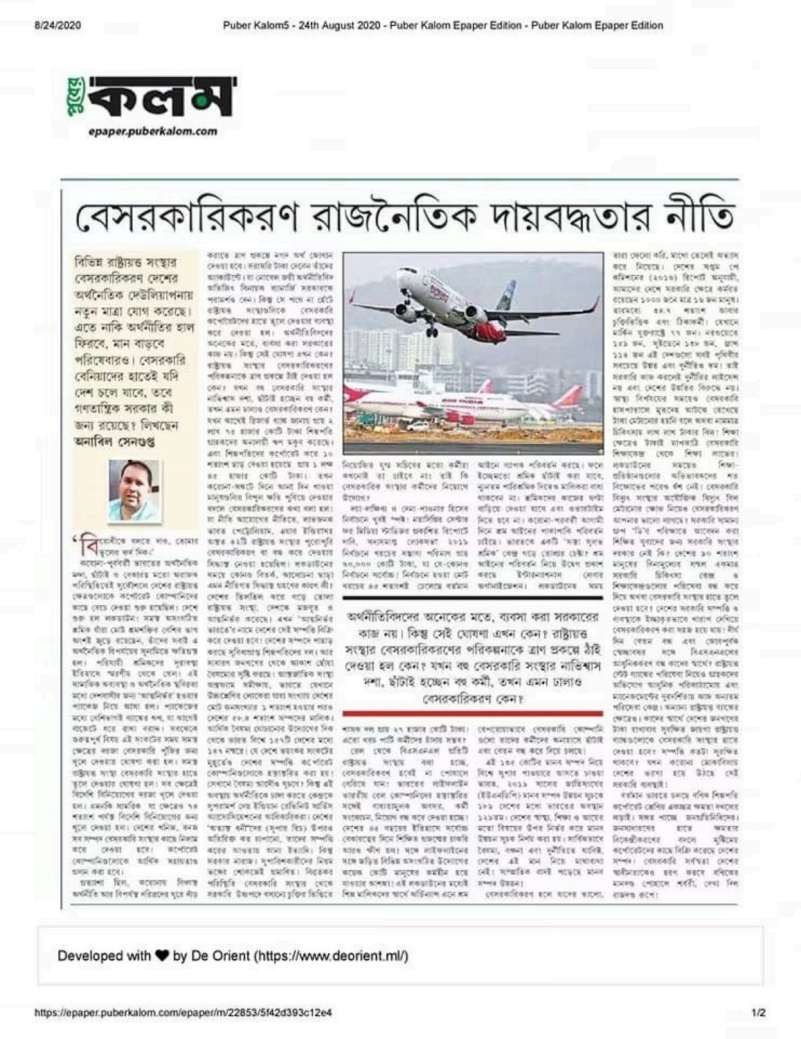
Plate 1 — Puber Kalam, 24 August 2020 — “Privatisation as a policy of political obligation”; published with the author’s photograph and byline. E-paper edition, epaper.puberkalam.com.
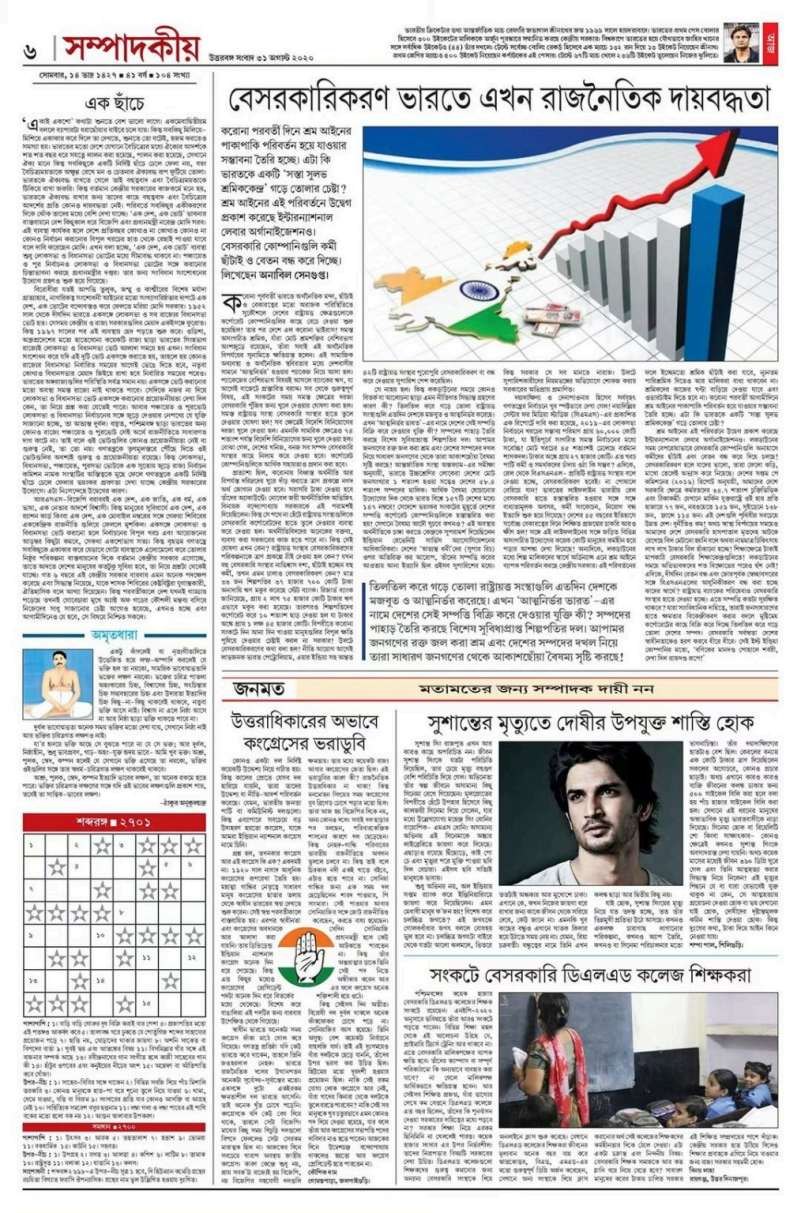
Plate 2 — Uttarbanga Sambad, 31 August 2020 (Monday, 14 Bhadra 1427) — “Privatisation is now a political obligation in India”, on the editorial page. The author’s photograph appears at the head of the slot; the name itself is not sharp enough to read on this scan.
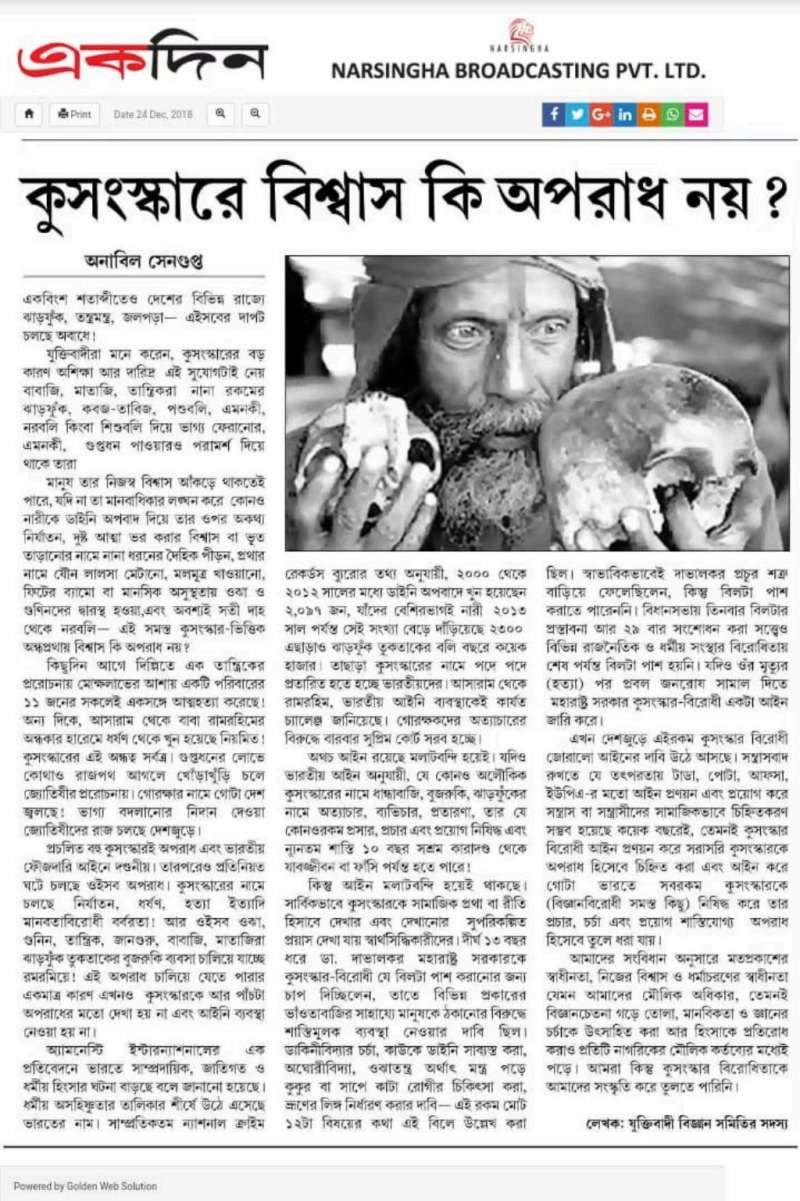
Plate 3 — Ekdin (Narsingha Broadcasting Pvt. Ltd.), 24 December 2018 — “Is belief in superstition not a crime?”; by Anabil Sengupta.
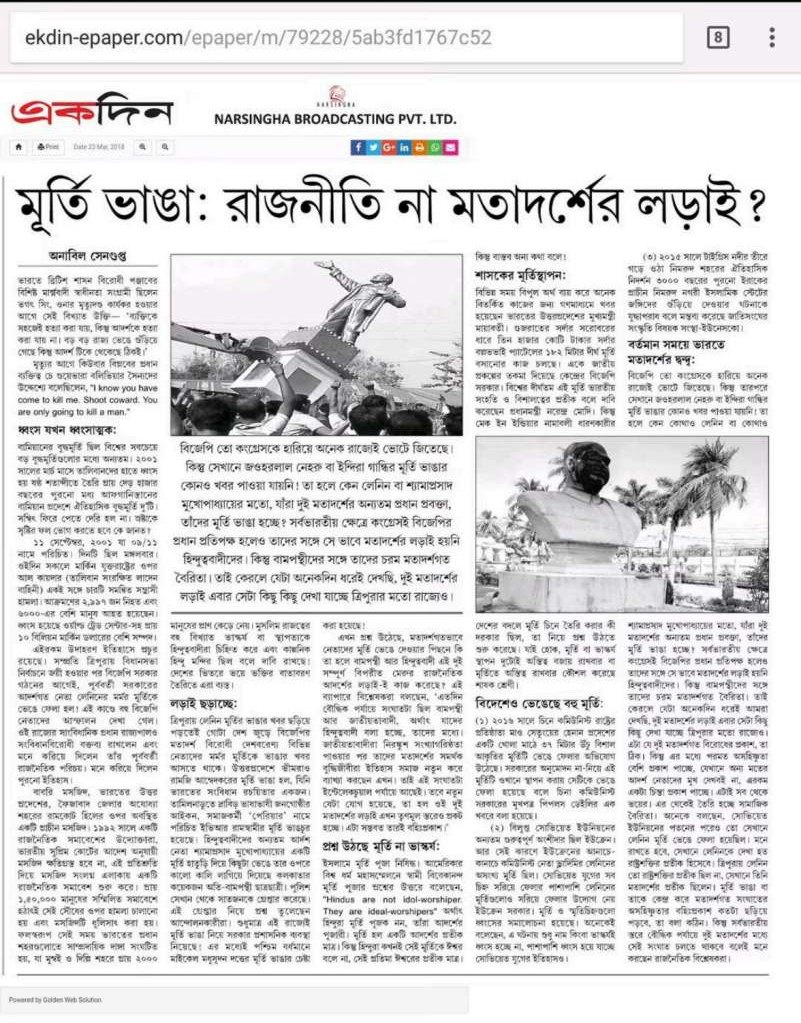
Plate 4 — Ekdin, 23 March 2018 — “Toppling statues: a fight over politics or over ideology?”; by Anabil Sengupta. The e-paper address ekdin-epaper.com is visible in the frame.
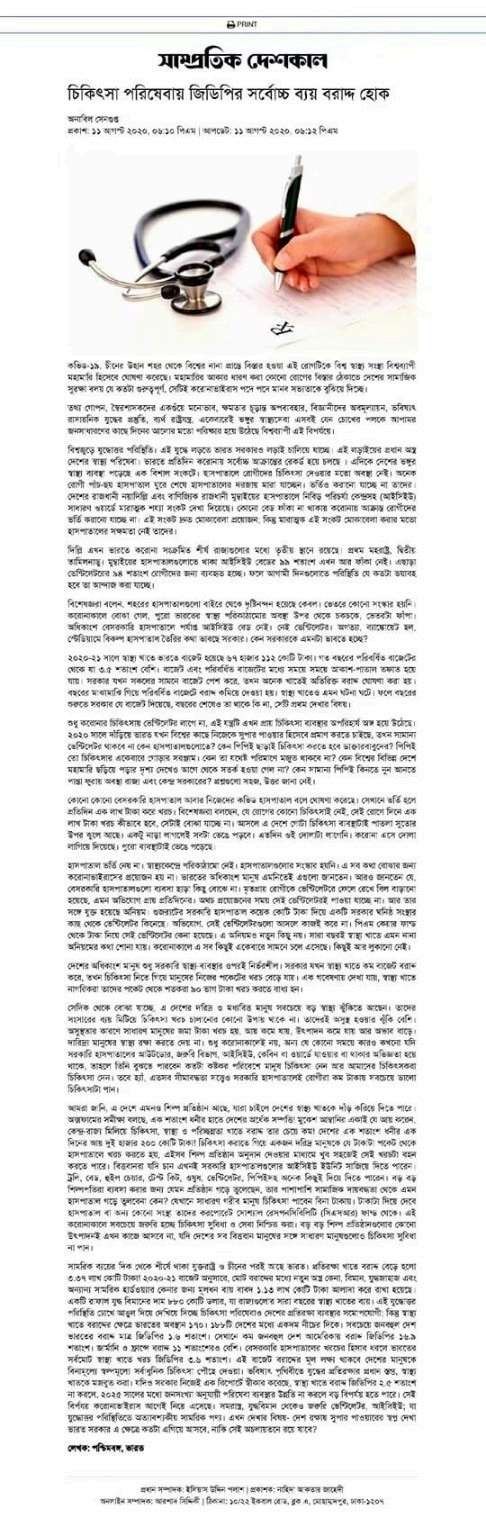
Plate 5 — Shampratik Deshkal (Bangladesh), published 11 August 2020 — “Let the largest share of GDP be allocated to health services”; by Anabil Sengupta.
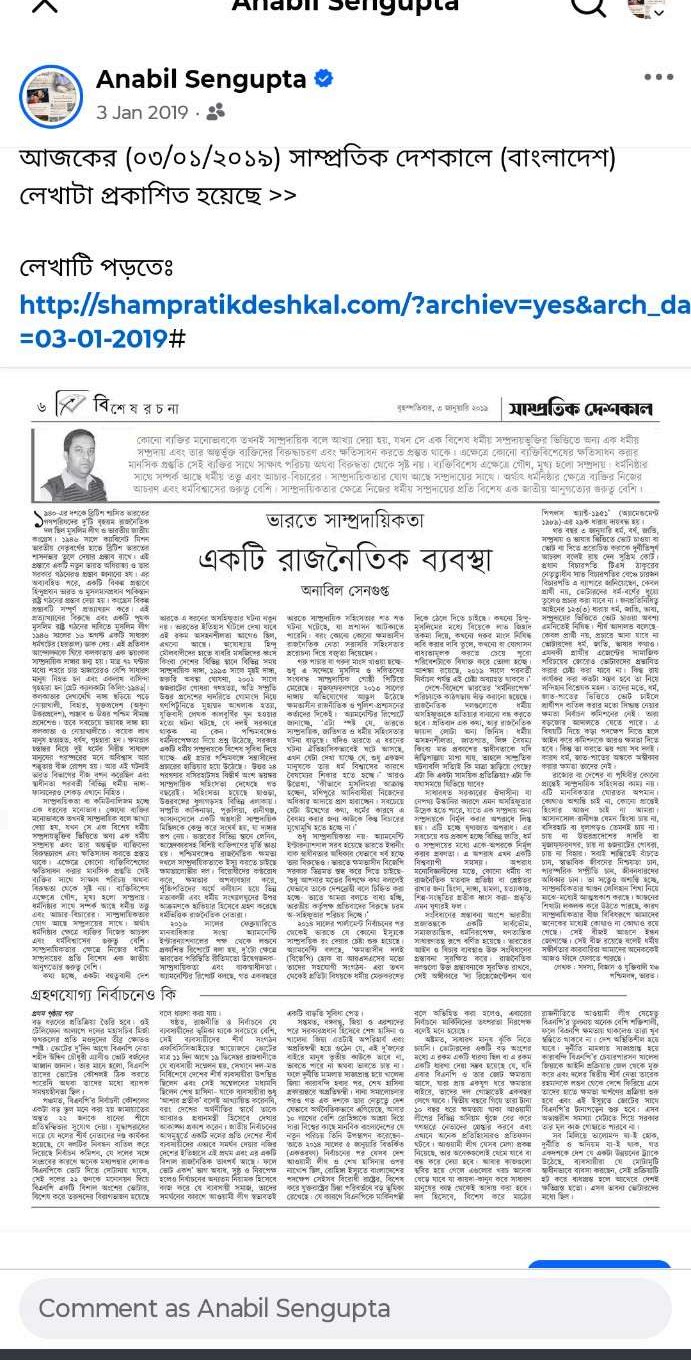
Plate 6 — Shampratik Deshkal (Bangladesh), 3 January 2019 — “Communalism in India: a political arrangement”; carried in the print edition with the author’s photograph and byline. The publication date is taken from the author’s own post accompanying the image.
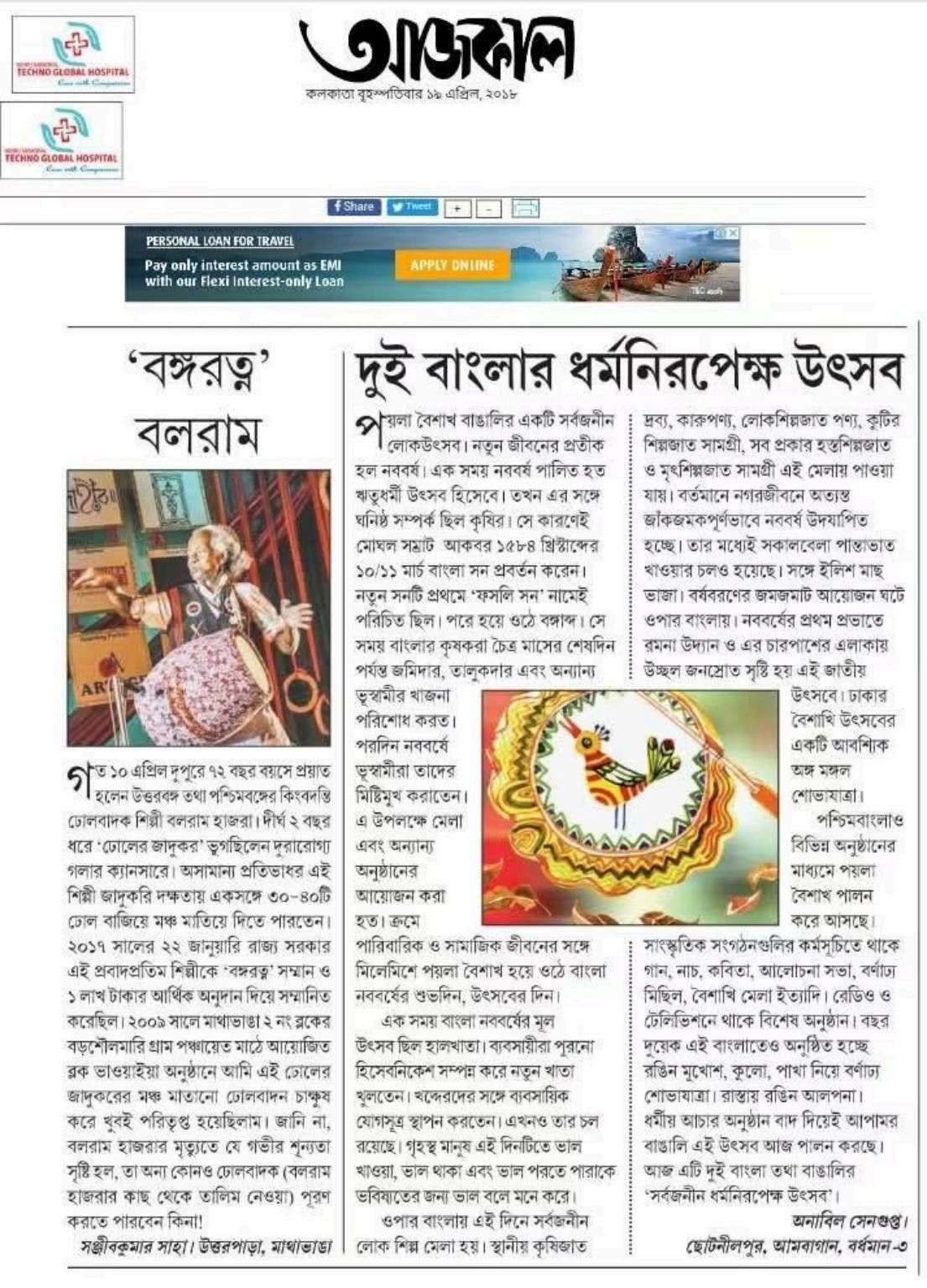
Plate 7 — Aajkaal, Kolkata, Thursday 19 April 2018 — “The secular festival of the two Bengals”; signed Anabil Sengupta, Chhotonilpur, Ambagan, Burdwan-3.
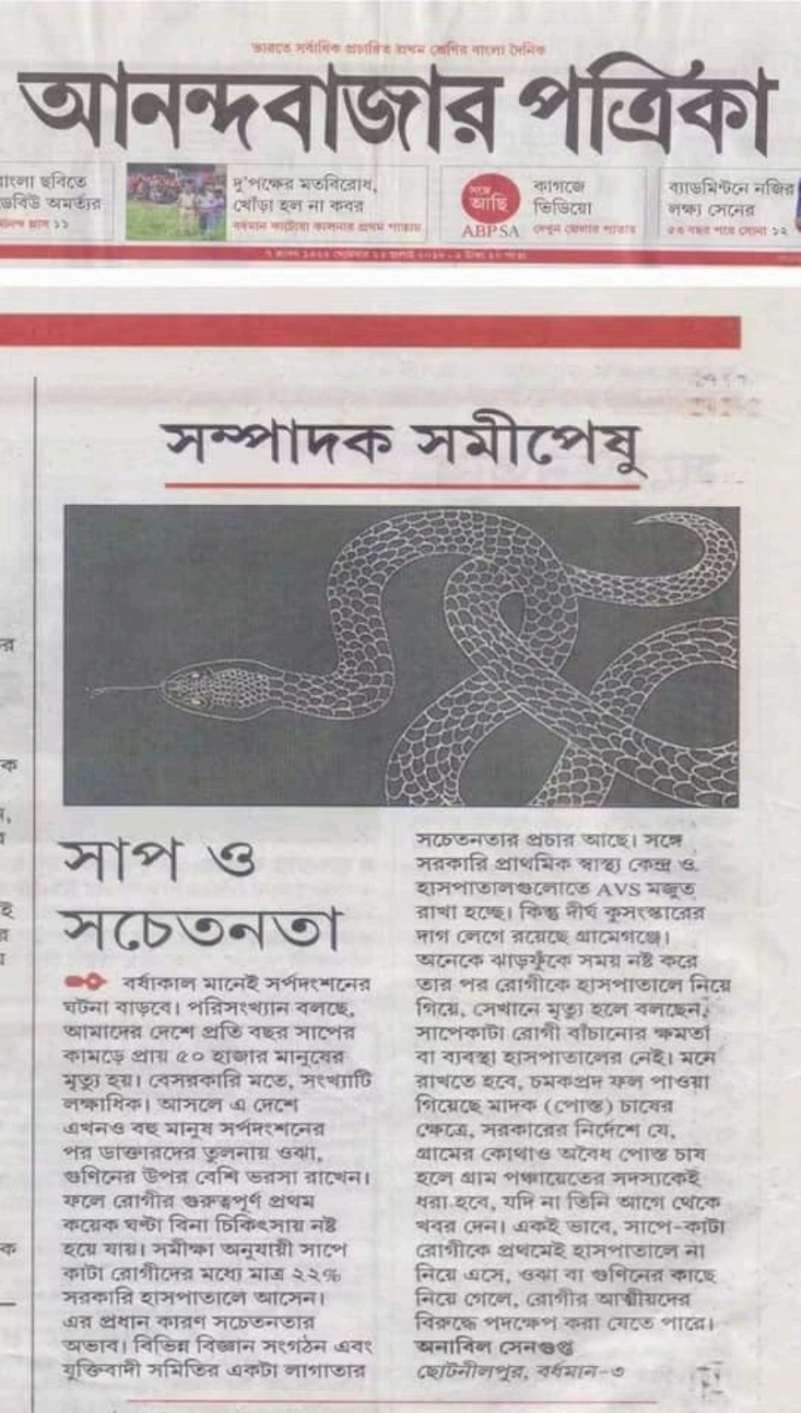
Plate 8 — Anandabazar Patrika, “Letters to the Editor” column — “Snakes and awareness”; signed Anabil Sengupta, Chhotonilpur, Burdwan-3. The date of publication is not visible on this image.
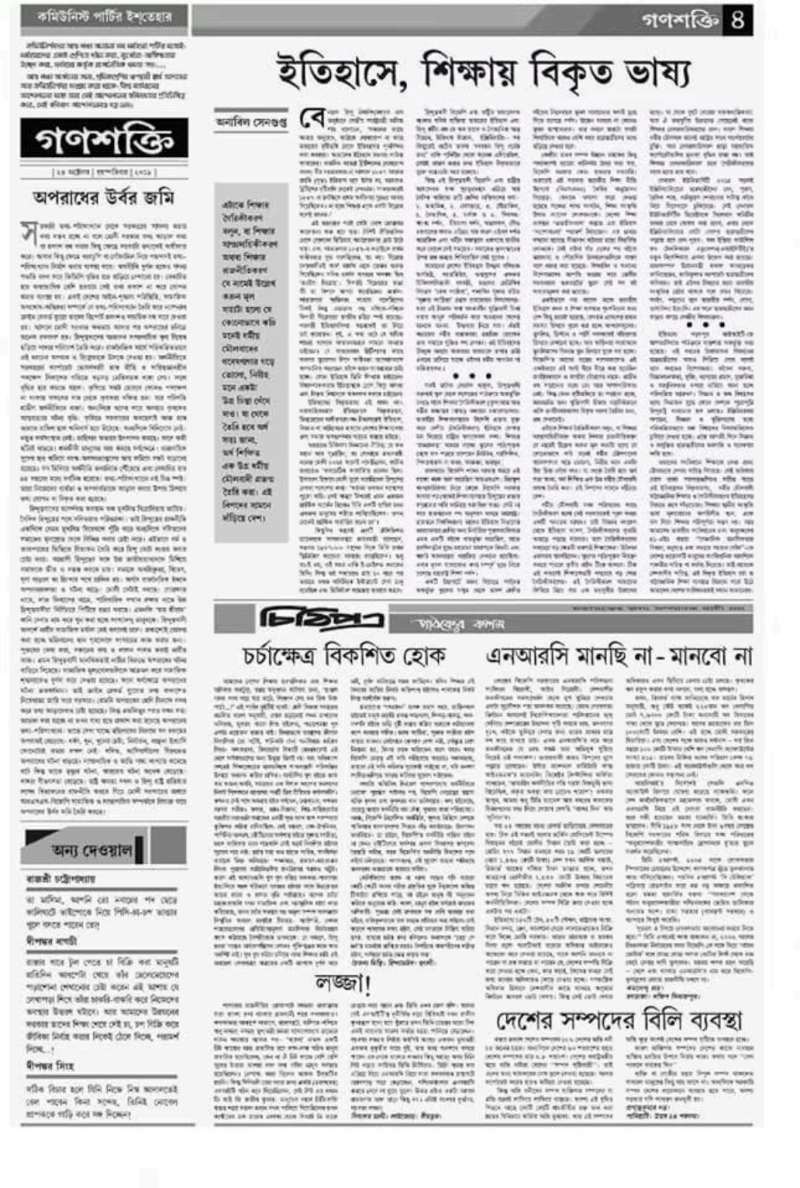
Plate 9 — Ganashakti — “Distorted narratives in history and in education”; by Anabil Sengupta. The masthead and byline are clear, but the date line beneath the masthead could not be read on this scan.
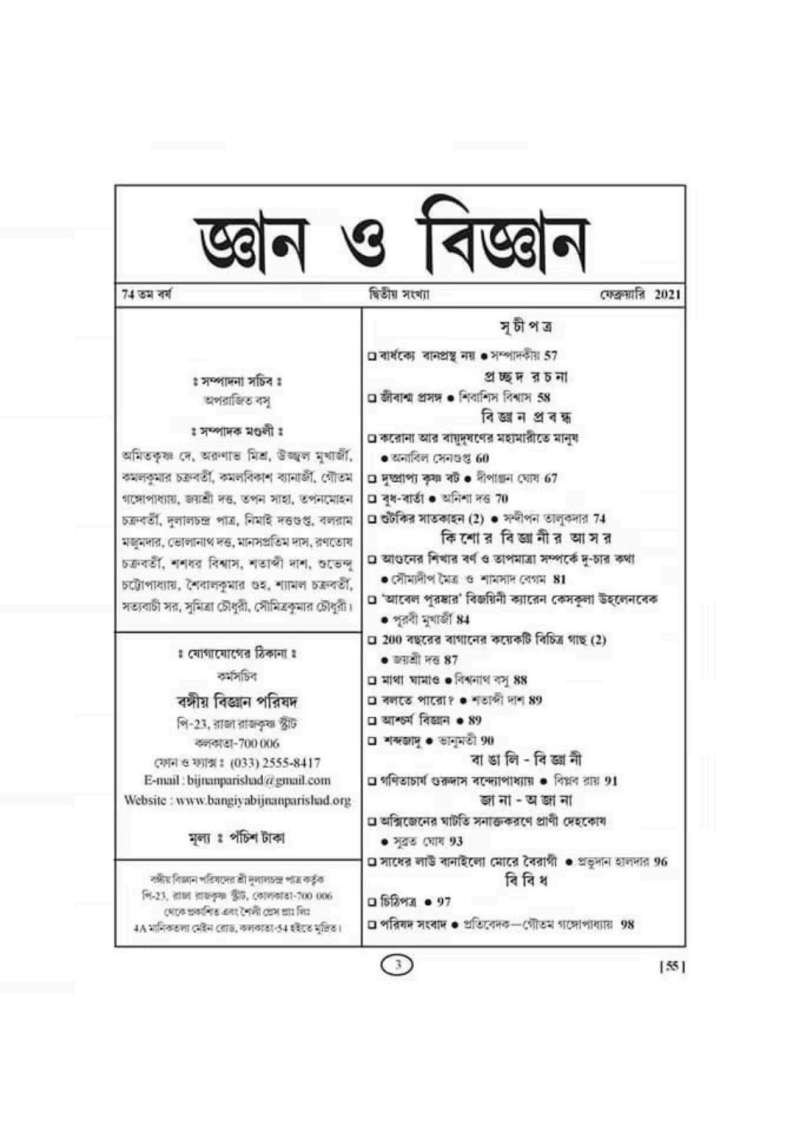
Plate 10 — Gyan O Bigyan (Bangiya Bigyan Parishad), Year 74, No. 2, 10 February 2021, ISSN 2454-7727 — the contents page lists “The twin epidemic of Covid and air pollution ● Anabil Sengupta, p. 60”.
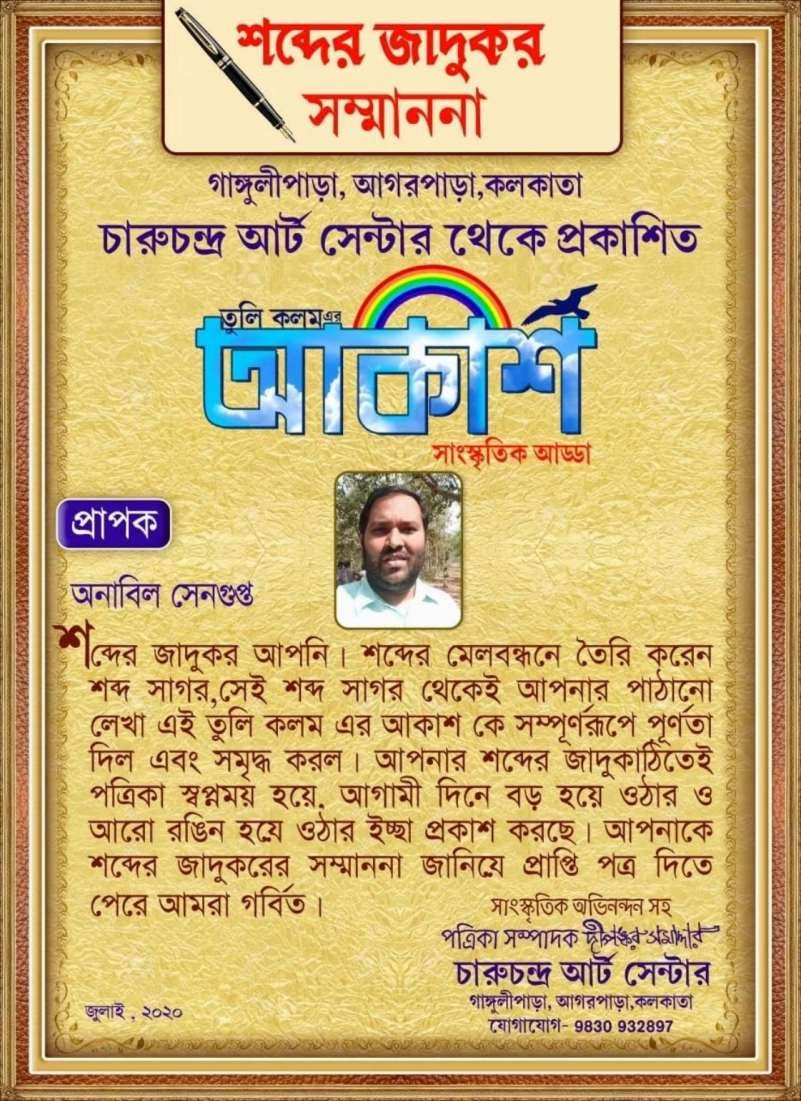
Plate 11 — “Shabder Jadukar” (Magician of Words) citation, July 2020 — awarded to Anabil Sengupta by the “Akash” cultural circle of Tuli Kalam, published from Charuchandra Art Centre, Gangulipara, Agarpara, Kolkata; carries the recipient’s photograph.
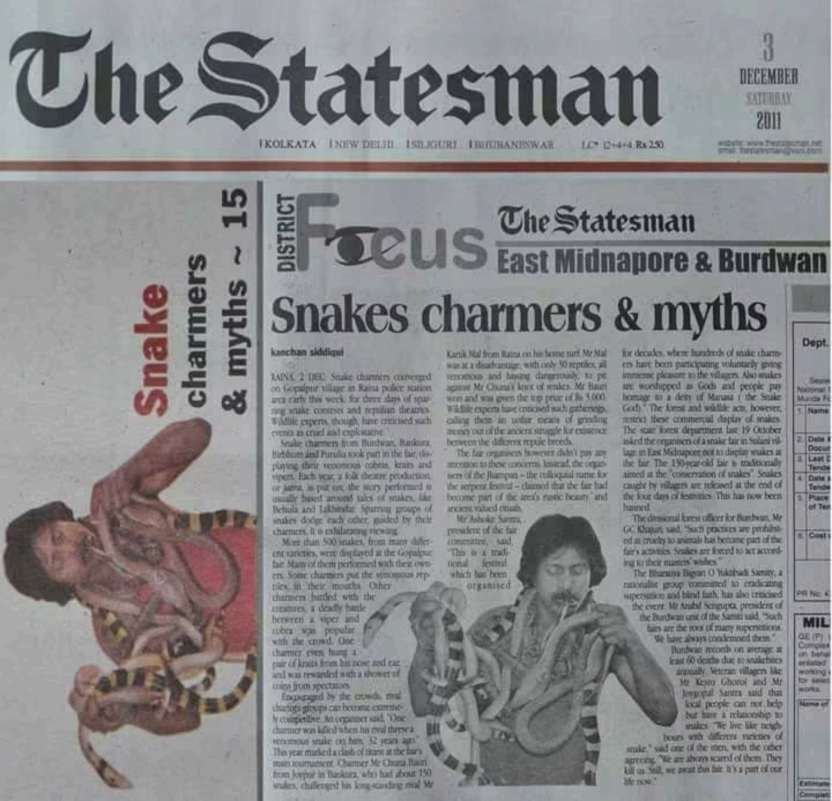
Plate 12 — The Statesman, Saturday 3 December 2011, “District Focus” (East Midnapore & Burdwan), p. 15 — “Snakes charmers & myths”. The report is by Kanchan Siddiqui; Anabil Sengupta is quoted in it as president of the Burdwan unit of the Bharatiya Bigyan O Yuktibadi Samity. This documents his being quoted, not his authorship.
References
A. The author’s primary and verified sources
- Anabil Sengupta, official website — https://anabilsengupta.com/
- Anabil Sengupta, “The Beliefs of Science, and …” (বিজ্ঞানের বিশ্বাস এবং …), LittleMag Unedited, December 2017 — https://www.littlemag.org/2017/12/science-and-belief.html
- Anabil Sengupta, “Toppling Statues: A Fight over Ideology?” (মূর্তি ভাঙ্গা : মতাদর্শের লড়াই?), LittleMag Unedited, March 2018 — https://www.littlemag.org/2018/03/demolition-statue-.html
- Anabil Sengupta, “Communalism: A Political Arrangement” (সাম্প্রদায়িকতা : একটি রাজনৈতিক ব্যবস্থা), LittleMag Unedited, April 2018 — https://www.littlemag.org/2018/04/religious-fundamentalism.html
- Anabil Sengupta, “Pahela Baishakh: The Bengali’s Universal Secular Festival” (পহেলা বৈশাখ : বাঙালির সার্বজনীন ধর্মনিরপেক্ষ উৎসব), LittleMag Unedited, April 2018 — https://www.littlemag.org/2018/04/bengali-new-year.html
- Anabil Sengupta, “The Twin Epidemic of Air Pollution and Coronavirus Will Shorten Human Life” (বায়ুদূষণের সাথে করোনাভাইরাসের যৌথমহামারীতে হ্রাস পাবে মানুষের জীবনকাল), LittleMag Unedited, October 2020 — https://www.littlemag.org/2020/10/air-polution-corona-pandemic.html
- Anabil Sengupta, “The Platinum Jubilee of Independence” (স্বাধীনতার প্লাটিনাম জয়ন্তী), LittleMag Unedited, August 2021 — https://www.littlemag.org/2021/08/blog-post.html
- Achetan (অচেতন) (YouTube channel) — https://www.youtube.com/@ANABIL-SENGUPTA
B. The Bharatiya Bigyan O Yuktibadi Samiti and Prabir Ghosh
- Bharatiya Bigyan O Yuktibadi Samiti / Science and Rationalists’ Association of India, official blog — https://sraiofficial.blogspot.com/
- “Science and Rationalists’ Association of India,” Wikipedia — https://en.wikipedia.org/wiki/Science_and_Rationalists%27_Association_of_India
- “Prabir Ghosh,” Wikipedia — https://en.wikipedia.org/wiki/Prabir_Ghosh
- “Prabir Ghosh Is Dead” (প্রবীর ঘোষ প্রয়াত), The Wall, 7 April 2023 (source for the date of death and for the 50 lakh rupee challenge figure) — https://www.thewall.in/west-bengal/bharatiya-bigyan-o-yuktibadi-samiti-founder-prabir-ghosh-died-at-78/tid/99435
- “Prabir Ghosh, Leader of the Rationalist and People’s Science Movement, Is Dead” (যুক্তিবাদী ও জনবিজ্ঞান আন্দোলনের পুরোধা প্রবীর ঘোষ প্রয়াত), People’s Reporter — https://www.peoplesreporter.in/science-and-technology/prabir-ghosh-the-leader-of-the-rationalist-movement-has-passed-away
- “Alaukik Noy, Laukik (Volume One)/Preface” (অলৌকিক নয়, লৌকিক (প্রথম খণ্ড)/ভূমিকা), Bengali Wikisource — https://bn.wikisource.org/wiki/অলৌকিক_নয়,_লৌকিক_(প্রথম_খণ্ড)/ভূমিকা (the page is publicly accessible; it returned HTTP 403 on retrieval, so the text could not be verified)
C. Sources on institutional identity and on the corrections
- “Kolkata Little Magazine Library And Research Center,” Wikipedia — https://en.wikipedia.org/wiki/Kolkata_Little_Magazine_Library_And_Research_Center
- “Remembering Sandip Dutta, Who Built Little Magazine Movement Book By Book,” Outlook India — https://www.outlookindia.com/national/building-it-book-by-book-news-271958
- Ganashakti (গণশক্তি), Bengali daily — https://bangla.ganashakti.co.in/ (the paper’s home page; the specific report of 24 October 2019 is not online)
Addresses not used as live sources (dead, blocked or transferred): www.srai.org (now the site of an unrelated American organisation); the Sangbad Pratidin e-paper deep link (HTTP 403); Ganashakti’s 2019 image asset (HTTP 404); and the kolkata24x7, catchnews and mukto-mona links relating to animal sacrifice (inactive or untraceable).
D. General sources for the historical background of Chapter 2
- “Ram Mohan Roy,” Encyclopaedia Britannica — https://www.britannica.com/biography/Ram-Mohan-Roy
- “Ishwar Chandra Vidyasagar,” Encyclopaedia Britannica — https://www.britannica.com/biography/Ishwar-Chandra-Vidyasagar
- “Akshay Kumar Datta,” Wikipedia — https://en.wikipedia.org/wiki/Akshay_Kumar_Datta
- “Prafulla Chandra Ray,” Wikipedia — https://en.wikipedia.org/wiki/Prafulla_Chandra_Ray
- “Bengal Renaissance,” Wikipedia — https://en.wikipedia.org/wiki/Bengal_Renaissance
- “Bangiya Bigyan Parishad,” Wikipedia (on the magazine Gyan O Bigyan) — https://en.wikipedia.org/wiki/Bangiya_Bigyan_Parishad
E. Principal data sources cited in the author’s writing (as acknowledged by him)
- World Health Organization (WHO) — reports on air pollution and public health — https://www.who.int/
- UNDP, Human Development Report 2019 — https://hdr.undp.org/
- Air Quality Life Index, Energy Policy Institute at the University of Chicago (EPIC) — https://aqli.epic.uchicago.edu/
- NASA Earth Observatory — observations of aerosol levels during the lockdown — https://earthobservatory.nasa.gov/
- The Lancet — studies on mortality from air pollution — https://www.thelancet.com/
- Oxfam International — reports on economic inequality — https://www.oxfam.org/
- Centre for Media Studies (CMS), New Delhi — reports on election expenditure — https://cmsindia.org/
Note on these sources: Section (E) indicates the institutions from which the principal data used in the author’s essays came. The figures in his writing are taken from reports of the 2017–2021 period; the current data of those bodies may differ in later editions.
F. Print publications: sources documented in the plates
Each of these entries is supported by a plate in this book or by a clipping in the author’s collection (see Chapter 5 and the “Plates” section). Where a date could not be established, no date is given.
- Anabil Sengupta, “Privatisation as a Policy of Political Obligation” (বেসরকারিকরণ রাজনৈতিক দায়বদ্ধতার নীতি), Puber Kalam, 24 August 2020, e-paper edition —
epaper.puberkalam.com(Plate 1) - Anabil Sengupta, “Privatisation Is Now a Political Obligation in India” (বেসরকারিকরণ ভারতে এখন রাজনৈতিক দায়বদ্ধতা), Uttarbanga Sambad, 31 August 2020, editorial page (Year 47, No. 104) (Plate 2)
- Anabil Sengupta, “Is Believing in Superstition Not a Crime?” (কুসংস্কারে বিশ্বাস কি অপরাধ নয় ?), Ekdin (Narsingha Broadcasting Pvt. Ltd.), 24 December 2018, e-paper edition —
ekdin-epaper.com(Plate 3) - Anabil Sengupta, “Toppling Statues: A Fight over Politics or over Ideology?” (মূর্তি ভাঙা: রাজনীতি না মতাদর্শের লড়াই?), Ekdin, 23 March 2018, e-paper edition (Plate 4)
- Anabil Sengupta, “The Dark Shadow of Religious Fundamentalism over Education” (শিক্ষায় ধর্মীয় মৌলবাদের কালো ছায়া), Ekdin, 09 March 2018; and “Strong Law Is Needed to Stop Communalism” (সাম্প্রদায়িকতা রুখতে চাই কড়া আইন), Ekdin, 21 December 2018; and “An Anti-Superstition Law Is in People’s Interest” (মানুষের স্বার্থেই কুসংস্কার বিরোধী আইন), Ekdin, November 2017 (the date taken from the author’s own post)
- Anabil Sengupta, “Let the Largest Share of GDP Be Allocated to Health Services” (চিকিৎসা পরিষেবায় জিডিপির সর্বোচ্চ ব্যয় বরাদ্দ হোক), Shampratik Deshkal (Dhaka), 11 August 2020, web edition —
shampratikdeshkal.com(Plate 5) - Anabil Sengupta, “Communalism in India: A Political Arrangement” (ভারতে সাম্প্রদায়িকতা: একটি রাজনৈতিক ব্যবস্থা), Shampratik Deshkal (Dhaka), 3 January 2019, print edition (Plate 6)
- Anabil Sengupta, “The Secular Festival of the Two Bengals” (দুই বাংলার ধর্মনিরপেক্ষ উৎসব), Aajkaal, Kolkata, Thursday 19 April 2018 (Plate 7)
- Anabil Sengupta, “Snakes and Awareness” (সাপ ও সচেতনতা), Anandabazar Patrika, “Letters to the Editor” column — date illegible on the clipping (Plate 8)
- Anabil Sengupta, “Distorted Narratives in History and in Education” (ইতিহাসে, শিক্ষায় বিকৃত ভাষ্য), Ganashakti, p. 4 — date line illegible on the clipping (Plate 9)
- Anabil Sengupta, “The Epidemic of Covid and Air Pollution” (করোনা আর বায়ুদূষণের মহামারী), Gyan O Bigyan, Bangiya Bigyan Parishad, Year 74, No. 2, 10 February 2021, p. 60 — ISSN 2454-7727 (Plate 10)
- Anabil Sengupta, “Unscientific” (অবৈজ্ঞানিক), Ei Samay, “Samantaral” column — date illegible on the clipping
- Anabil Sengupta, “The Wounded Lover” (ব্যথিত প্রেমিক) (poem), Uttaran, book-fair issue, 1410 Bengali era / 2003 (the year from the author’s own account and from the Bengali era date on the page)
- “Shabder Jadukar” citation, the “Akash” cultural circle of Tuli Kalam, Charuchandra Art Centre, Gangulipara, Agarpara, Kolkata, July 2020 (Plate 11)
- Banglalive.com — third place in the flash-fiction (অণুগল্প) competition; results page and e-mail from the editorial desk — https://banglalive.com/ (no date on the documents)
Where he is not the author but the person quoted:
- Kanchan Siddiqui, “Snakes charmers & myths,” The Statesman, District Focus (East Midnapore & Burdwan), p. 15, Saturday 3 December 2011 — quoting Anabil Sengupta as “president of the Burdwan unit of the Samity” (Plate 12)
- Staff Reporter, “The Consequence of Superstition: The ‘Ghost’ Will Not Let Go, Young Man Kills Himself in Terror” (কুসংস্কারের জের: পিছু ছাড়ছে না ‘ভূত’, আতঙ্কে আত্মঘাতী যুবক), Sangbad Pratidin, Bardhaman, 12 April 2017 — quoting Anabil Sengupta as “secretary of the Burdwan branch of the Bharatiya Bigyan O Yuktibadi Samiti”
Note on the sources in this section: The documents for entries 31–47 are photographs from the author’s own collection; they have not been independently retrieved from publishers’ archives. The e-paper addresses visible in the images (ekdin-epaper.com, epaper.puberkalam.com, epaper.eisamay.com, epaper.sangbadpratidin.in) are short-retention links and may not open today; that is why they are given here not as live sources but as an indication of the edition. The proper route to verification is the paper’s own archive, under the date stated.
Index
(Because page numbers change between editions, references here are to chapters. Pre = Preface, C1–C6 = Chapters 1 to 6, Con = Conclusion, PK = Press Kit, Pl = Plates.)
A
- Aajkaal — C5, Pl
- AAOS / AAOS Implementation Manual — C5
- Achetan (YouTube channel) — C5, PK
- Air pollution — C3(c), C5, PK
- Air Quality Life Index — C3(c)
- Akshay Kumar Datta — C2
- Alaukik Noy, Laukik — C2, C5
- Ambagan, Chhotonilpur — C1, PK
- Anabil Sengupta — throughout
- Anandabazar Patrika — C3(b), C5, Pl
- Animal sacrifice — C3(a), C6, PK
- Anti-snake venom (ASV) — C3(b), C5, PK
B
- Bangiya Bigyan Parishad — C2, C5
- Banglalive.com — C5
- “The Beliefs of Science, and…” — C1, C5
- Bharatiya Bigyan O Yuktibadi Samiti — C2, C3(a), C6, PK
C
- Chandana Nandi — C4
- Charuchandra Art Centre / Tuli Kalam — C5, Pl
- Climate change — C3(c), PK
- Cobra — C3(b)
- Communalism — C3(d), C5
- Covid-19 — C3(c), C3(d)
E
- Ei Samay — C3(b), C5
- Ekdin — C5, C6, Pl
- Election expenditure — C3(d)
- Evidence, tiers of — Pre, C6
- Exposed Emotions — C5, PK
G
- Ganashakti — C4, C5, C6, Pl
- Ghosh, Prabir — C2, C6
- Ghosh, Souvik — C4
- Gyan O Bigyan (magazine) — C2, C5, C6, Pl
I–K
- Ishwar Chandra Vidyasagar — C2
- ISSN 2454-7727 — C5, C6, Pl
- Joutho Mahamari / The Twin Pandemic — C5
- Juktir Aloy / In the Light of Reason — C5
- Kanchan Siddiqui — C5, C6, Pl
- Krait — C1, C3(b)
L
- Labour law — C3(d), PK
- Little Magazine Library and Research Centre — C5, C6
- LittleMag Unedited (littlemag.org) — C1, C3(c), C5, C6
- Lockdown — C3(c), C3(d)
M–N
- Manteswar — C4
- Monocled cobra — C3(b)
- NASA — C3(c)
- 4 Number Platform — C5
O–P
- Oxfam — C1, C3(d)
- Plates (documentary evidence) — Pre, C5, C6, Pl
- “Policy Follows the Obligations of Big Capital” — C1, C3(d), C5
- Prabir Ghosh — C2, C6
- Prafulla Chandra Ray, Acharya — C2
- Puber Kalam — C3(d), C5, Pl
- Purba Bardhaman (East Burdwan) — Pre, C1, C4, PK
R–S
- Rabindranath Tagore — C3(a)
- Raina-1 (block) — C4
- Raja Rammohan Roy — C2
- Rule of 100 — C3(b), C5, PK
- Russell’s viper — C3(b)
- Sandip Dutta — C5, C6
- Sangbad Pratidin — C3(a), C4, C5, C6
- “Shabder Jadukar” citation — C5, Pl
- Shampratik Deshkal (Dhaka) — C5, Pl
- Snakebite — C1, C3(b), C5, PK
- Soumen Banik (BDO) — C4
- srai.org (domain changed hands) — C2, C6
- The Statesman — C2, C3(a), C5, C6, Pl
- Superstition — C2, C3(a), PK
T–U
- “The Platinum Jubilee of Independence” — C5
- “Toppling Statues: A Fight over Ideology?” — C3(d), C5
- Ujjwal Uddhar (magazine) — C6
- UNDP — C1, C3(c), C3(d)
- Uttarbanga Sambad — C3(d), C5, C6, Pl
- Uttaran (magazine) — C5